Western Sydney Airport Noise Abatement Procedure Overview

A Noise Abatement Procedure (NAP) is a procedure designed to reduce the impact of aircraft noise on the community. Theya re implemented by Air Traffic Control (ATC), airports or airport owners. They contain instructions for pilots and ATC for the runways, flight paths and procedures that should be followed, where safe, to minimise the impacts of aircraft noise on the community.

Airservices Australia has the following published NAP at Western Sydney Airport

Reporting is available for:

  • Preferred Runway Operations
  • Reciprocal Runway Operations (RRO) NAP

The first report for the above will be available as soon as practicable, in early December 2026.

The following NAPs are not able to be reported on by Airservices Australia as we do not have ready access to the required data:

  • Use of Noise Abatement Departure Procedures (NADPs)
  • Landing reverse thrust

It is important to note that NAPs are not mandatory; ATC and pilots apply the NAPs whenever possible.

The below overview provides monthly movement numbers, runway usage, and the types of aircraft operating at Western Sydney Airport. Note that the percentages shown at each end of the runway represent the proportion of arrivals or departures using that direction.
Reciprocal Runway Operations (RRO) and RRO Noise Abatement Procedure (NAP) Report

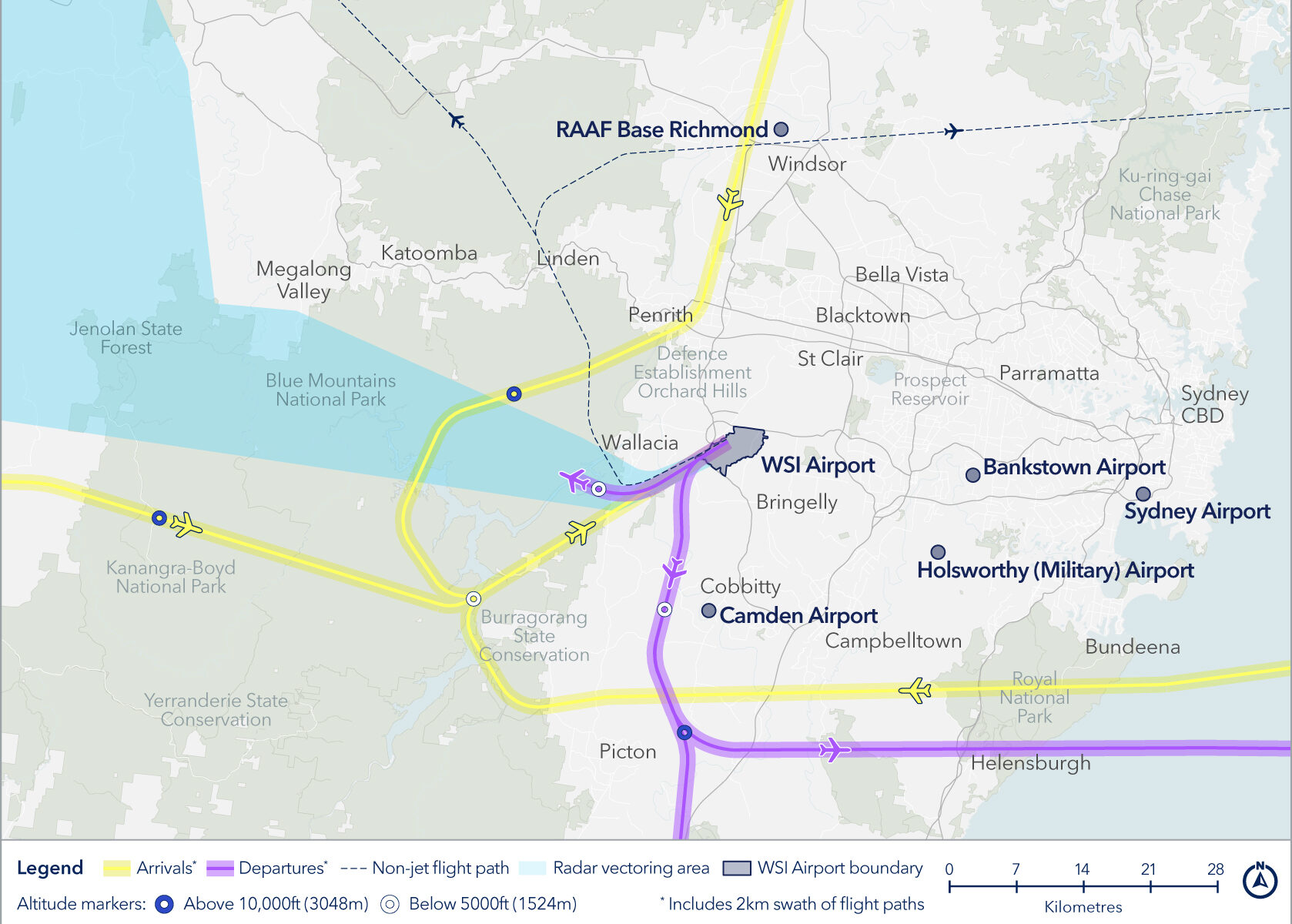
WSI is expected to use RRO (aircraft depart to the south-west and arrive from the south-west) as its preferred runway mode between 11pm and 5.30am. For RRO to be used, all the following conditions must be met:

  • Tailwinds (including gusts), must not exceed 5 knots (approximately 9km/hour)
  • The runway surface must be dry, including free of dew or fog
  • Low traffic levels – due to the opposing-direction movements of aircraft. For safety reasons, a departing aircraft cannot take off if an arriving aircraft is within 20 nautical miles (approximately 37km) of the airport. If traffic levels increase, ATC will switch to using Runway 23 or Runway 05

When RRO is in use, a NAP for RRO has also been developed to further minimise these impacts by tactically directing aircraft off the designated flight paths and around communities when lower traffic volumes allow. The following conditions, in addition to the RRO conditions listed above, must be met for RRO-NAP to be used:

  • Due to opposing-direction movements of aircraft, RRO NAP can only be applied when arriving aircraft are more than 30 nautical miles, approximately 56km from WSI. If traffic levels increase, ATC will switch to using RRO, Runway 23 or Runway 05

More information about RRO and RRO-NAP can be found in the RRO factsheet.

As per the ministerial direction, reporting on RRO and RRO NAP utilisation rates will commence at the end of the first month of commercial passenger flights from WSI. The first report will be available as soon as practicable in early December 2026.

WSI Reciprocal Runway Operations — Weekly Report (SAMPLE)

WSI Reciprocal Runway Operations — Weekly Report (SAMPLE)

Illustrative placeholder data — demonstrates the report generator only

Generated: 27-Aug-2026  |  Timezone: AEST (UTC+10)

Runway mode utilisation

Hours spent in each runway mode across the reporting week. Values below are illustrative placeholders only.

Hours in mode, by runway mode (whole week)
Hours in mode, by runway mode (whole week) Bar chart of hours in each runway mode for the week: Mode 05 sixty-two hours, Mode 23 forty-eight hours, Reciprocal twenty-one hours, Transition seven hours. 0 16 32 48 64 80 Mode 05 Mode 23 Reciprocal Transition Runway mode Hours in mode (h) Hours: 62 h 62 h Hours: 48 h 48 h Hours: 21 h 21 h Hours: 7 h 7 h
Show data table for this chart
Data for Hours in mode, by runway mode (whole week)
Runway modeHours
Mode 0562 h
Mode 2348 h
Reciprocal21 h
Transition7 h
Mode utilisation summary (whole week, illustrative)
Runway modeHours in mode (h)Share of week (%)
Mode 056244.3
Mode 234834.3
Reciprocal2115.0
Transition75.0
Total138100.0

Weather gating

Reciprocal availability against weather gates (tailwind and visibility), by day. Values are illustrative placeholders only.

Reciprocal hours: available vs weather-gated, by day
Reciprocal hours: available vs weather-gated, by day Grouped bar chart comparing available reciprocal hours against weather-gated hours for each day of the week. Illustrative placeholder values. Available (h) Weather-gated (h) 0 1 2 3 4 5 Mon Tue Wed Thu Fri Sat Sun Day of week Hours (h) Available (h): 3.5 3.5 Weather-gated (h): 1 1 Available (h): 4 4 Weather-gated (h): 0.5 0.5 Available (h): 2.5 2.5 Weather-gated (h): 2 2 Available (h): 5 5 Weather-gated (h): 0.5 0.5 Available (h): 3 3 Weather-gated (h): 1.5 1.5 Available (h): 1.5 1.5 Weather-gated (h): 2.5 2.5 Available (h): 1 1 Weather-gated (h): 3 3
Show data table for this chart
Data for Reciprocal hours: available vs weather-gated, by day
Day of weekAvailable (h)Weather-gated (h)
Mon3.51
Tue40.5
Wed2.52
Thu50.5
Fri31.5
Sat1.52.5
Sun13

Transition activity

Count of mode transitions per day across the week. Values are illustrative placeholders only.

Mode transitions per day
Mode transitions per day Line chart of the number of runway mode transitions per day across the week, ranging from two to seven. Illustrative placeholder values. 0 1.6 3.2 4.8 6.4 8 Mon Tue Wed Thu Fri Sat Sun Day of week Transitions (count) Transitions: 4 4 Transitions: 3 3 Transitions: 6 6 Transitions: 2 2 Transitions: 5 5 Transitions: 7 7 Transitions: 3 3
Show data table for this chart
Data for Mode transitions per day
Day of weekTransitions
Mon4
Tue3
Wed6
Thu2
Fri5
Sat7
Sun3
Transition counts and mean transition duration, by day (illustrative)
DayTransitions (count)Mean duration (min)
Mon412.5
Tue310.0
Wed614.2
Thu29.5
Fri511.8
Sat713.0
Sun310.7
Airservices Australia — WSI Reciprocal Runway Operations. This is a SAMPLE report; all values are illustrative placeholders generated for layout and accessibility testing, not operational data.

Preferred Runway Operations

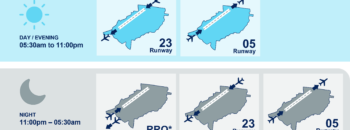
Preferred runways are part of Western Sydney Airport’s Noise Abatement Procedures (NAP). There are different preferred runways during the daytime and overnight period:

During the daytime period (5:30am-11pm):

Priority 1: Arriving and departing Runway 23 (arriving from the north-east and departing to the south-west)

Priority 2: Arriving and departing Runway 05 (arriving from the south-west and departing to the north-east)

During the overnight period (11pm-5:30am):

Priority 1: Reciprocal Runway Operations (RRO) (arriving and departing from the south-west)

Priority 2: Runway 23 (arriving from the north-east and departing to the south-west)

Priority 3: Runway 05 (arriving from the south-west and departing to the north-east)

There will be reporting function that provides the percentage of each operating mode during daytime and night-time periods for each month. The first report will be available as soon as practicable, in early December 2026.