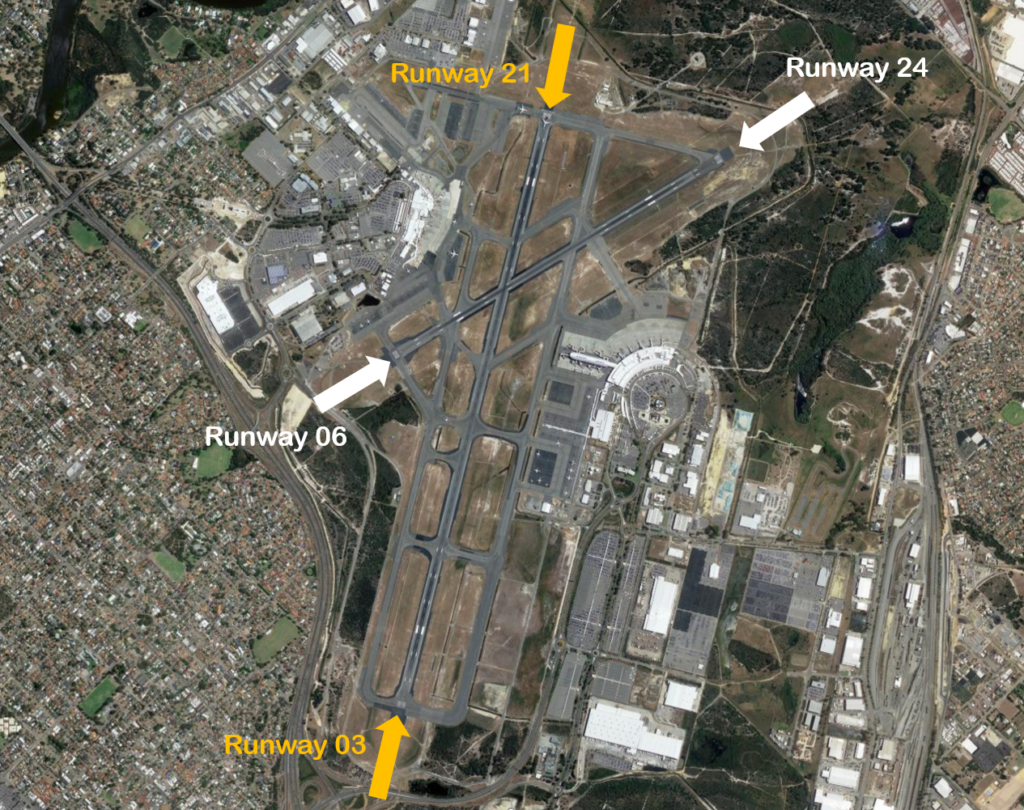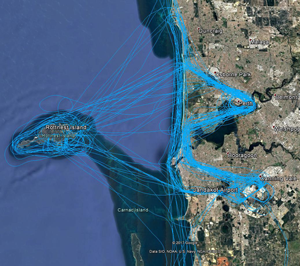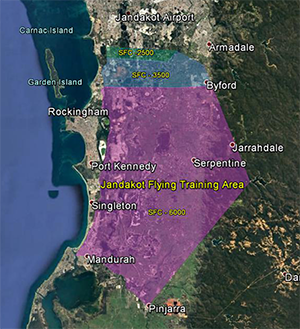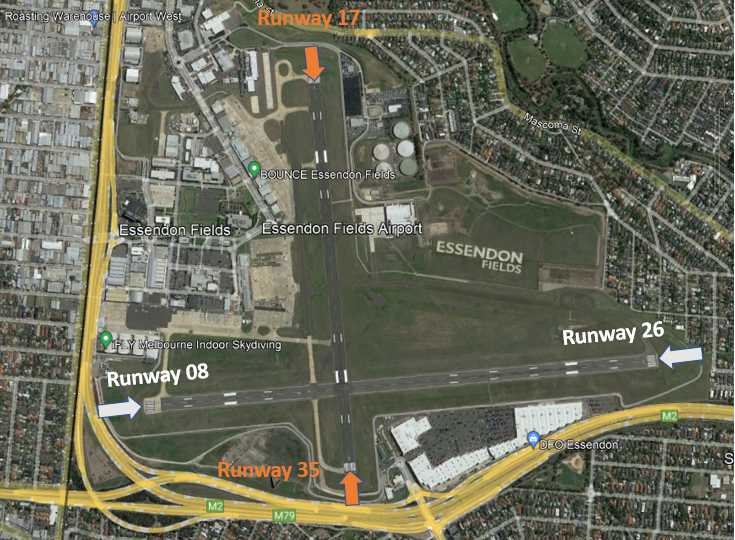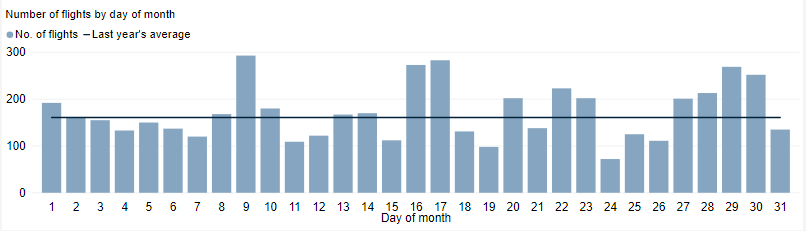
The NAP lists the preferred flight paths as:
2.1 Minimum Height Over Residential Areas
- Turbo-prop aircraft – minimum altitude of 3,000 ft AGL.
- Jet aircraft – minimum altitude of 5,000 ft AGL.
Note: Unless specified otherwise (see Clause 2.2), air traffic control apply these minimum heights for noise abatement purposes.
This NAP is under review to determine how it can be reported
2.2 Departures to the east of Perth
- Aircraft departing to the east of Perth on SIDs will be kept on track until leaving an altitude of 8,000ft except when required for operational reasons
*A SID is a published route aircraft use to safely travel through the busy airspace surrounding airports. Aircraft follow this route from departure to where they transition to the enroute (high-level airspace) phase of their flight. Procedural SIDs act like a road, providing an established path for aircraft to track along. They make separation from other aircraft easier and air traffic control more predictable.
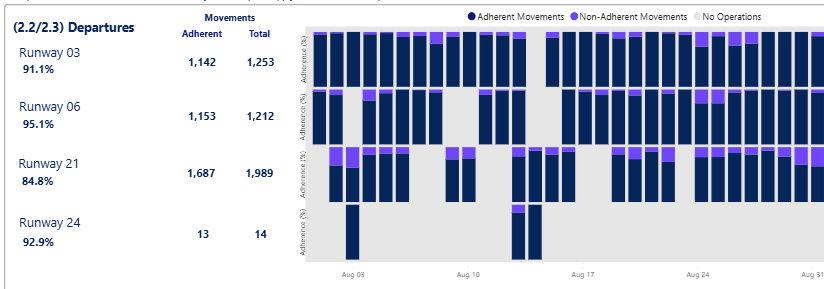
Adherence with this procedure is reported below (combined with 2.3).
2.3 Departures
- Air traffic control (ATC) shall normally process departing aircraft using standard departure paths (SIDs)
- When not following a procedural SID, use flight paths that approximate the SID tracks where possible
Notes for 2.2 and 2.3:
Adherence with SID procedures 2.2 and 2.3 combined is shown in the graphs below, reported up to 10,000ft adherence. Lower adherence rates are typically due to aircraft being taken off a SID to track a more direct route to their destination, once above 5,000ft (in line with minimum heights in Clause 2.1).
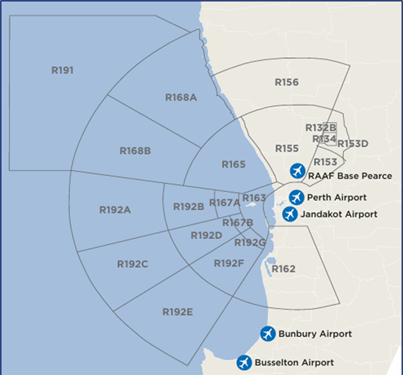
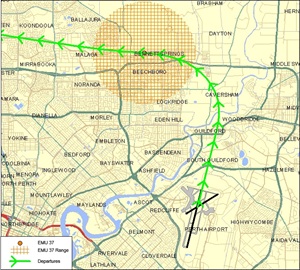
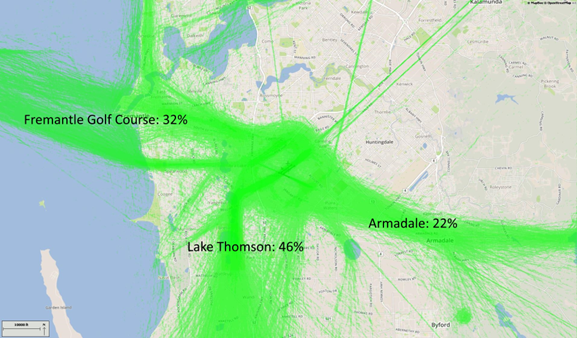
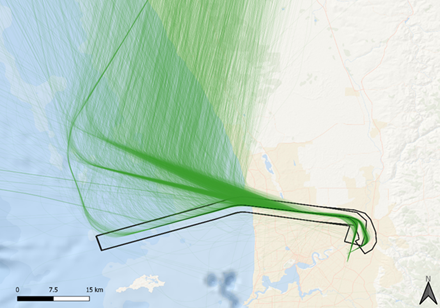
Due to the close proximity of Air Force Base Pearce military airspace to the north, Perth Airport SIDs are designed to take civilian aircraft around/ above the military airspace when it is active. When Pearce airspace is not in use, it is common practice for civilian aircraft to fly a more direct route to the north. The image to the right shows a SID route over water in black used when Pearce military airspace is active, and a sample of actual aircraft departure tracks from 2025 in green, taking a more direct route when Pearce airspace is not in use). To learn more about the Pearce airspace, click here.
2.4 Arrivals
- Arriving aircraft must be processed via standard arrival paths (STARs)* where available
- Only deviate from STAR path if essential for sequencing arrivals or separation with other aircraft
*A STAR is a published arrival route aircraft use to safely travel through the busy airspace surrounding airports. STARs help organise the flow of arriving air traffic and ensure aircraft arrive in a safe and orderly manner.
STARs are connected to the airport runway by various approach procedures, which are selected based on aircraft technology and weather conditions.
Adherence with this procedure is reported below
Notes:
Adherence is reported up to 10,000ft. Lower adherence results are typically due to aircraft being guided off the STAR path when at higher altitudes above 5,000ft (in line with minimum heights in Clause 2.1).
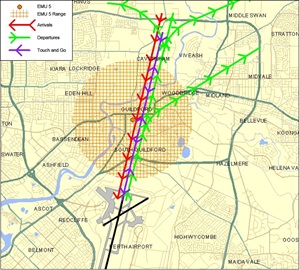
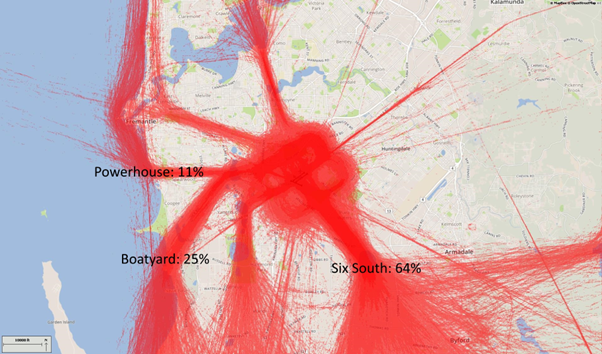
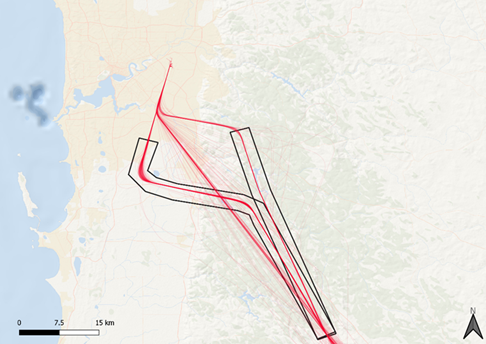
Air traffic controllers can sometimes guide a plane off the STAR path and give it a more direct route prior to joining the final runway-aligned landing path. Controllers do this to keep safe spacing between planes, manage traffic flow, and make the landing process more efficient. The image to the right shows an example of arrivals to Perth Airport from the south – STAR routes are in black, with a sample of actual aircraft arrival tracks from 2025 in red. The middle straight red line shows aircraft taken off the STAR path for a more direct route.
2.5 Non-STAR Tracking
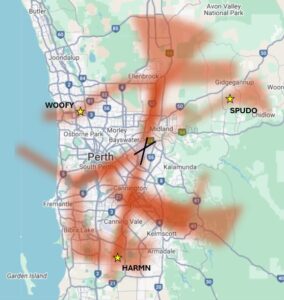
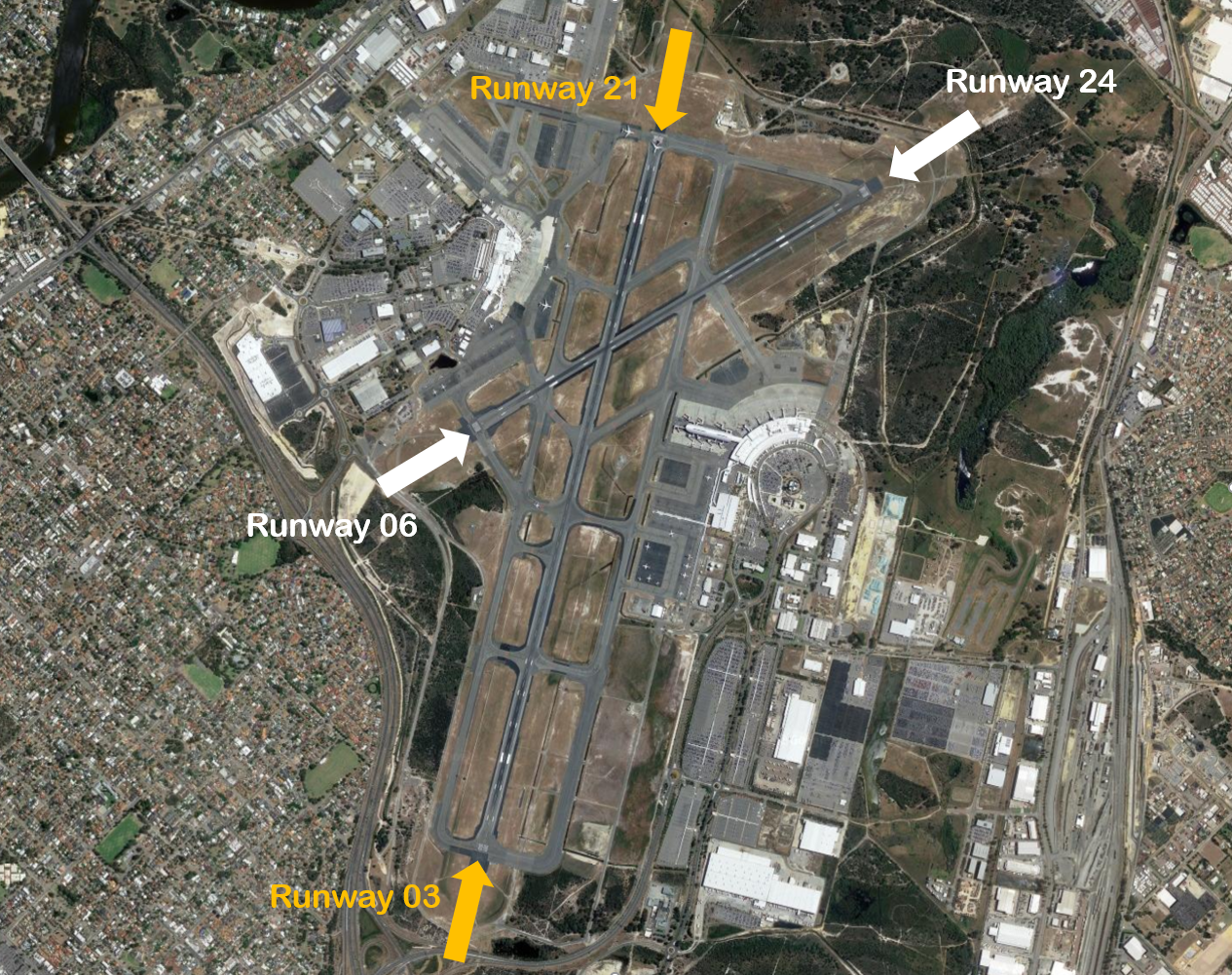
Non-STAR tracking must approximate STAR tracks or comply with minimum height requirements, with specific exceptions for each landing runway direction (e.g. visual approaches where pilots navigate by visual landmarks instead of procedures, and other exceptions based on the direction of arrival). These exceptions are:
- Landing runway 21, arriving from the south
- Aircraft at or below 45000kg maximum take-off weight can fly visually using a left turn to join final approach
- Landing runway 21, arriving from the west
- via waypoint WOOFY to 6 nautical miles from Runway 21 for a visual approach
- Landing runway 24, arriving from the south
- via waypoint SPUDO
- Landing runway 03, arriving from the south or west
- via waypoint HARMN for an Instrument Landing System (ILS) approach
- track to 5 nautical miles from Runway 03 for visual approach
- Landing runway 06, arriving from the southwest or west
- track west of the coast to conduct a straight in approach
Waypoints – A waypoint is a geographical location used to define a point on a flight path. Waypoints are defined by geographic coordinates and typically take the form of a five-letter capitalised word e.g. WOOFY, SPUDO, HARMN.
Standard Instrument Departures (SID) and Standard Instrument Arrivals (STARs) are published flight paths designed to enhance safety, efficiency, and predictability. Air traffic control (ATC) may issue a deviation to a SID or STAR due to weather and/ or traffic conditions.
Due to a technical issue, the January 2026 reporting figures for Clause 2.5 initially captured only STAR‑adherent movements. This issue was corrected on 2 April 2026, and the figures have been updated to include non‑STAR tracking movements as well.
The report is best viewed in full screen mode.
Note: Due to rounding, percentage values may not sum to exactly 100.0%. Minor discrepancies of up to ±1% are expected and do not indicate any errors in the underlying absolute figures, which remain accurate and unaffected.