

Perth Airport Flight Paths
Flight paths are not precise, defined paths like runways, but more like corridors that are often several kilometres wide.
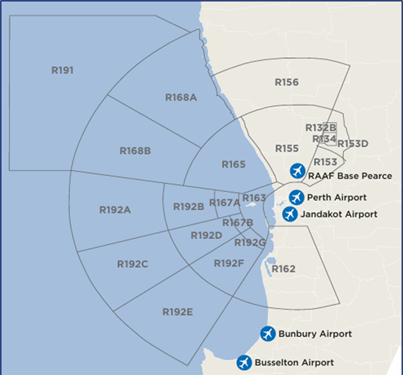
Perth Airport flight paths are designed around RAAF Base Pearce’s military restricted airspace to the north, west and south, and Jandakot Airport airspace to the south.
Military airspace
The Pearce military restricted areas are shown in the image on the right. Pearce restricted airspace are typically active between Monday to Thursday from 8am to 5pm, and Friday 8am to 3pm local time.
Where possible, flight paths for Perth Airport are designed to remain under Pearce military airspace or to fly over the top of it. Because of Pearce’s close proximity, air traffic controllers at Perth Airport must coordinate their actions with RAAF controllers, including for changes of runway direction.
Arrival flight paths
Most aircraft arriving at Perth Airport use satellite‑based navigation technology, known as Performance Based Navigation (PBN). This allows aircraft to follow arrival paths with a high level of accuracy and consistency. PBN was initially referred to as Smart Tracking and has been progressively implemented across the airport since its introduction on Runway 03 in 2015.
Jet arrivals into Perth are generally aligned with the runway at least ten kilometres from the airport. From this point they will fly towards the runway in a straight line. This means that suburbs in line with the runways are overflown by arriving jets. Other suburbs may be overflown by aircraft proceeding towards the point at which they join the final approach and align with the runway. There is no minimum altitude for aircraft in process of landing. Aircraft will generally descend on a glide slope of three degrees.
Runways 03, 21 and 24 have Instrument Landing Systems (ILS). This type of approach requires aircraft to be at around 3000 feet when they begin their approach to the runway. Aircraft will descend steadily to the runway using the horizontal and vertical guidance provided by the system. ILS is especially important in poor visibility or bad weather.
Departure flight paths
Departure flight paths allow aircraft to maintain the runway heading for a short time until they are stabilised in flight, and then to turn towards the route that will take them to their destination.
Around 60 per cent of all departures from Perth Airport depart to the south from Runway 21. Nearly two-thirds of this 60 per cent are heading for the eastern states and international ports such as New Zealand. These flights will turn left (east) from Runway 21. Around 40 per cent of this 60 per cent are aircraft heading for destinations to the west, north and north-west such as South Africa, the Middle East, Asia, Karratha, Paraburdoo and Port Hedland. These aircraft will turn right (west) after departure from Runway 21.
When Runway 03 is in use aircraft with westerly and northerly destinations will turn left. Some will continue northwards if military airspace is not active. Runway 03 is often used in combination with Runway 06, that is, both runways will be in use for departures at the one time. This means that air traffic controllers can only turn aircraft departing from Runway 03 right if it will not conflict with traffic departing Runway 06. When Runway 06 is used for departures, most of the domestic traffic to the eastern states will use that runway which minimises the need for aircraft to turn right from Runway 03.
The altitude of aircraft after departure will depend on factors such as the type of aircraft and its weight, how heavily laden it is with fuel and passengers, and the atmospheric conditions at the time. All these factors affect an aircraft’s climb rate. There is no regulated minimum altitude for an aircraft in the process of taking off.
Flight path information
You can access historical information about flight path use through WebTrak. To access this information click the “Historical” link below the text in the Quick Start Guide at the top left-hand side of the screen. Then use the tick boxes at the bottom-right of the screen to select monthly, quarterly or yearly information. Use the sliders to refine your selection to specific timeframes.
To learn more about the runways at Perth Airport, take a look at our Perth Airport Runway page.
The illustration below shows how jet and non-jet (turbo-prop) aircraft typically operate at Perth Airport on the published instrument arrival and departure flight paths.
The animation is indicative only and provided for information purposes, on occasions flights may leave these general areas from time-to-time.