Learn about flight paths and aircraft movements in your area
Welcome to the Aircraft in Your Neighborhood Portal
Our goal is that you will learn more about the flight paths and aircraft movements in your area and be able to access the information and resources that explain how air traffic is managed.
First, please select your location using one of the following options, so that we can customize the information for your location.
We’ll remember your location so you don’t have to enter it every time you visit the site and we’ll keep this information confidential.
Please note, that this site works best on Chrome, Firefox and Edge.
* Mandatory - Select region first to view the map.
An Instrument Landing System (ILS) is a navigational aid that emits radio signals to provide vertical and horizontal guidance to pilots landing in low-visibility and inclement weather conditions. This type of system requires a flight path that extends in a straight line from the runway.
Airports without an ILS can experience higher levels of missed approaches, unstable approaches and in some cases, diversions to alternate airports when safe landing is not possible.
The Gold Coast ILS
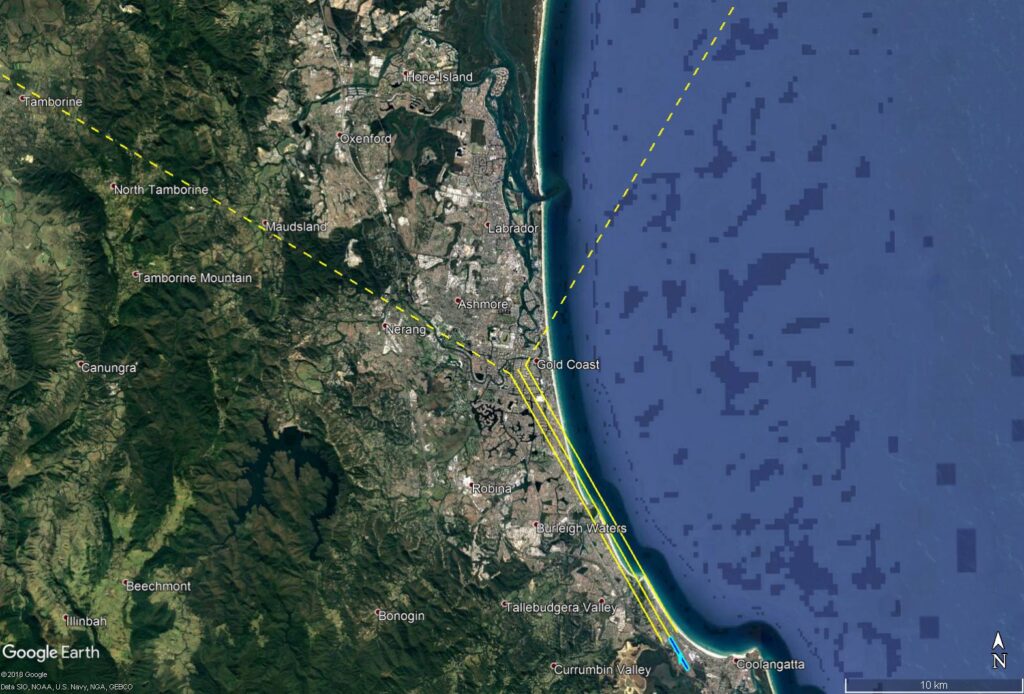
An ILS was introduced at Gold Coast Airport in early 2019. The below image shows the ILS flight path.
The ILS is designed so that arriving aircraft are vectored by Air Traffic Control within the triangular area between the dotted yellow lines (the ‘vectoring corridor’) to intercept the ‘straight-in’ ILS approach path (solid yellow lines).
ILS Flight Paths at Gold Coast Airport
Usage of the Gold Coast ILS
Analysis of flight tracks found that total ILS usage for a year (from February 2019 to February 2020) was 833 arrivals, which included 442 jet arrivals (53%) and 391 turbo prop/piston arrivals (47%). Turbo-props made up approximately 6% and piston aircraft approximately 41%. Piston aircraft are typically training aircraft under 5,700kg and therefore allowed to use the ILS under the NAPs (see NAPs section below).
On the busiest day of the year, the ILS was used 45 times. For the majority of the year (349 days), ILS usage was less than 8 arrivals per day.
Use of the ILS is seasonal due to weather patterns (e.g. storms and low visibility conditions). February 2020 was the most common month of usage, with 28% (235 arrivals) of all use occurring in this month. August 2019 was the least common month of usage with only 20 arrivals.
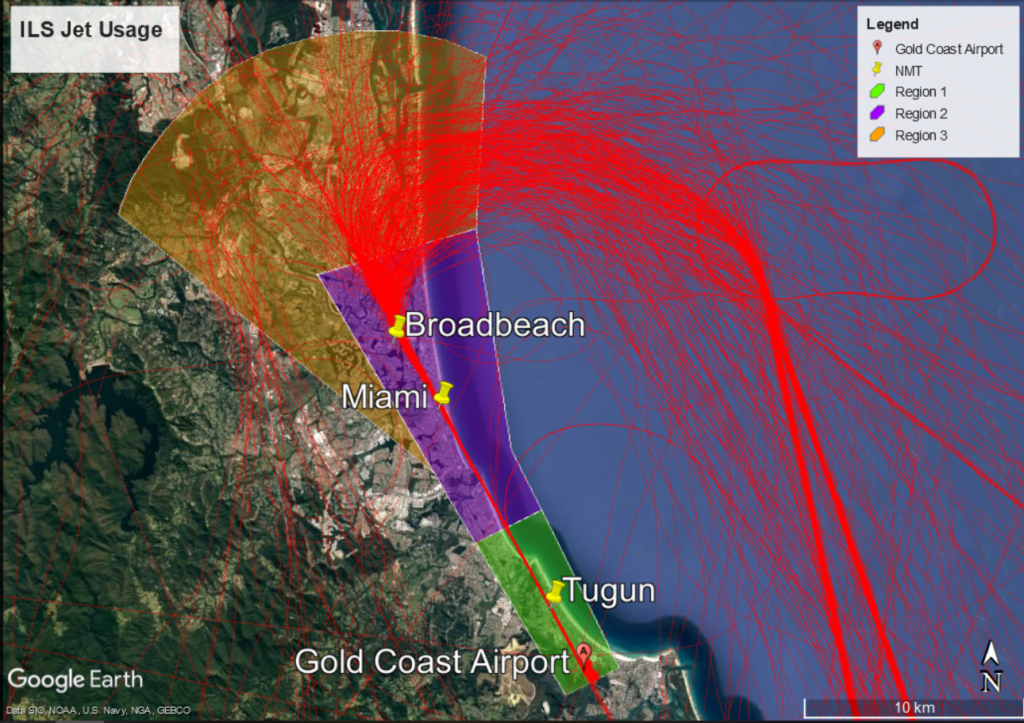
Jet aircraft (red) using the ILS to Runway 14 – February 2019 to February 2020
Jet aircraft are are broadly distributed (including those arriving from the south) as they approach to join the ILS. Once on the ILS their flight paths become increasingly concentrated.
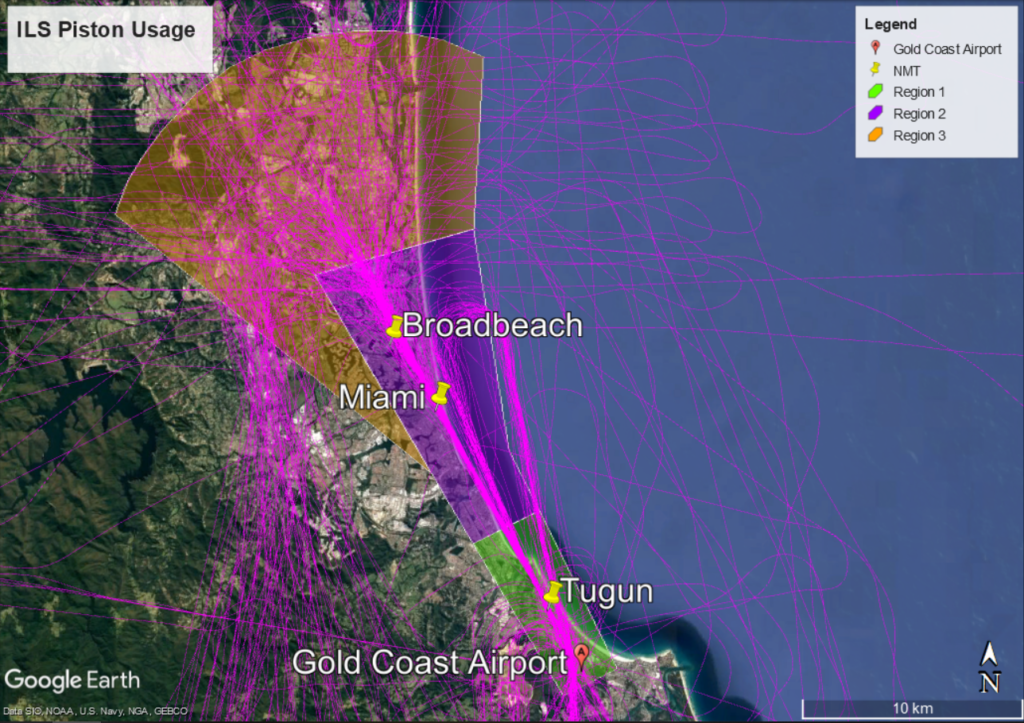
Piston aircraft (pink) using the ILS to Runway 14 – February 2019 to February 2020
Piston aircraft remain more broadly distributed than jet and turbo-prop aircraft before narrowing their approach closer to the airport.
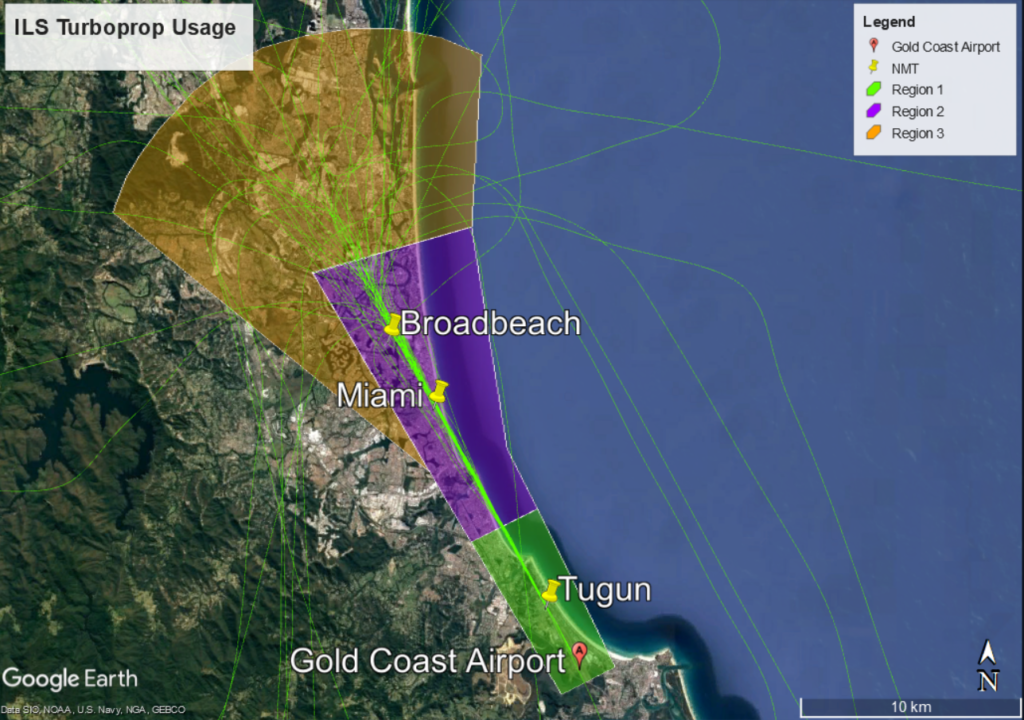
Turbo-prop aircraft (green) using the ILS to Runway 14 – February 2019 to February 2020
Turbo-prop aircraft are broadly distributed as they approach to join the ILS. Once on the ILS their flight paths become increasingly concentrated.
Noise Abatement Procedures for the ILS
Noise Abatement Procedures (NAPs) at Gold Coast Airport restrict use of the ILS except in the following circumstances:
when poor weather affects visibility
for operational requirements,
or during emergencies.
The objective of the NAPs it to limit the use of the ILS and minimise noise impacts on the community.
Weather
Weather conditions that affect visibility include low cloud and rain. When making an approach the pilot must be able to see the runway on reaching a prescribed altitude known as the “decision altitude”. If the pilot cannot see the runway by this point the landing will be aborted and a missed approach conducted. In a missed approach or “go-around” the pilot increases power, ascends and flies a circuit to prepare for a second approach. The decision altitude when using other approaches at Gold Coast Airport varies between 570 to 430 feet, while the decision altitude when using the ILS is reduced to 330 feet. Therefore the ILS provides more opportunity to land in poor visual conditions.
Air traffic control advise pilots to use the ILS when:
the cloud base is at or below approximately 800 feet (244 metres), and/or
the visibility from the air traffic control tower looking out along the ILS flight path is less than approximately 4 kilometres.
Visibility from the control tower is assessed with reference to geographical features at known distances. The ILS is nominated for use once the visibility of Tugun Hill from the tower is reduced due to weather. Tugun Hill is located 4 kilometres from the tower.
Operational requirements
The NAPs for the Preferred Approaches for Runway 14 require that the ILS be used as the last priority approach, except due to weather or operational requirement. The NAPs priority order is:
‘Smart Tracking’ (RNP-AR) approach
Area Navigation (RNAV) approach or Visual approach
Instrument Landing System (ILS) approach
If a pilot requests use of the ILS due to operational requirements, air traffic control (ATC) must follow this request. To ensure safe operation of their aircraft, the pilot-in-command always has the final say about what type of approach they require.
Training
The ILS can be used for training purposes, but:
is not permitted for aircraft with a maximum take-off weight (MTOW) above 5,700kg
is permitted for aircraft with a maximum take-off weight (MTOW) below 5,700kg (light aircraft) only between the hours of 9am and 5pm local time.
Compliance with ILS conditions of use
Of the 442 jet aircraft that arrived on the ILS (from February 2019 to February 2020), 90% used it when ATC had nominated it as the approach due to the cloud base and low visibility conditions outlined in the NAPs.
Approximately 10% of jets used the ILS approach when it was not nominated by ATC.
Reasons for this are:
aircraft attempted to fly the RNP-AR or RNAV approach, and could not sight the runway at the required decision altitude so conducted a missed approach and were then directed by ATC to use the ILS approach due to visibility
pilots advised of critical operational requirements due to on-board navigational equipment issues or emergencies
airline crews prepared for approach using the ILS and either misunderstood the application of the NAPs, or were unfamiliar with operations at Gold Coast Airport.
The ILS was not used by jet or larger turbo-prop aircraft for training.
Analysis of overall arrivals to Runway 14 found that jet and turbo-prop aircraft are using preferred approaches in the order outlined in the NAPs:
48% used the RNP-AR procedures
17% used RNAV or Visual approaches
13% used the ILS approach procedure
Over 18% of general aviation flew visual or VOR approaches.
Gold Coast ILS Post Implementation Review
In 2020 we undertook a Post Implementation Review (PIR) of the Gold Coast ILS arrival procedures.
The Gold Coast is popular with domestic and international tourists and this creates demand for helicopter joy flights and scenic helicopter tours. In general, these operations increase when the weather is fine and clear and during holiday periods. There also tends to be an increase of this activity coinciding with Chinese New Year celebrations.
There are a significant amount of helicopters involved in recreational activities in and around the Gold Coast area. They operate from helipads in the Southport area, such as Sea World and the Marina Mirage. These helicopter activities are considered as ‘standard operations’ and are permitted.
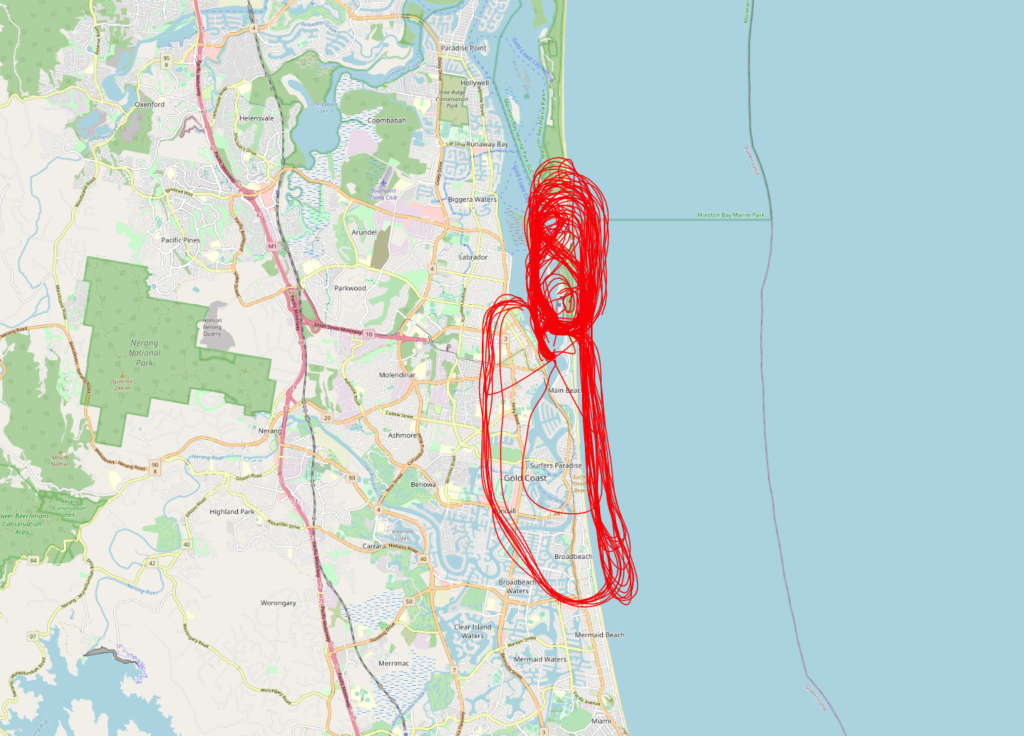
An extract of the typical paths used by these aircraft is shown in the following image:
The majority of light aircraft and helicopters operate outside or underneath controlled airspace, and this is the case for the helicopters operating at the northern end of the Gold Coast. As the airspace is uncontrolled, these operations are not under the direction of air traffic control however Civil Aviation Safety Authority Regulations still apply and must be adhered to.
Helicopter tour companies use a number of noise mitigation strategies such as varying their tracking to ensure they are not overflying the same residences each flight. Pilots are instructed to climb as quickly as possible and to avoid situations that increase rotor blade slap.
Helicopters, like fixed-wing aircraft land and take-off into the wind for safety reasons. This means the wind direction at the helipad usually determines whether or not they depart to the north or to the south. While the scenic route is similar regardless of the departure direction, residents will observe flights in opposite directions at times and as a result the altitudes of the helicopters may differ between flights.
Visit Engage Airservices to engage with our program of flight path and airspace changes.
Airport Master Plans
Airport Master Plans provide a blueprint for the future development of an airport over a twenty year period. They include information on forecast growth, airport terminals and facilities, runways and flight paths.
The trial looked at spreading out the jet departure paths for flights to specific destinations (including Malaysia, New Zealand, Japan, Townsville, Mount Isa and Cairns) in order to reduce the noise exposure to residents at Fingal Head, while maintaining minimal impact to other residential areas.
The trial reduced movements over the central area of Fingal Head, however community consultation showed that there was no support for the trial to be implemented permanently.
The flight path was not permanently implemented and the investigation was closed.
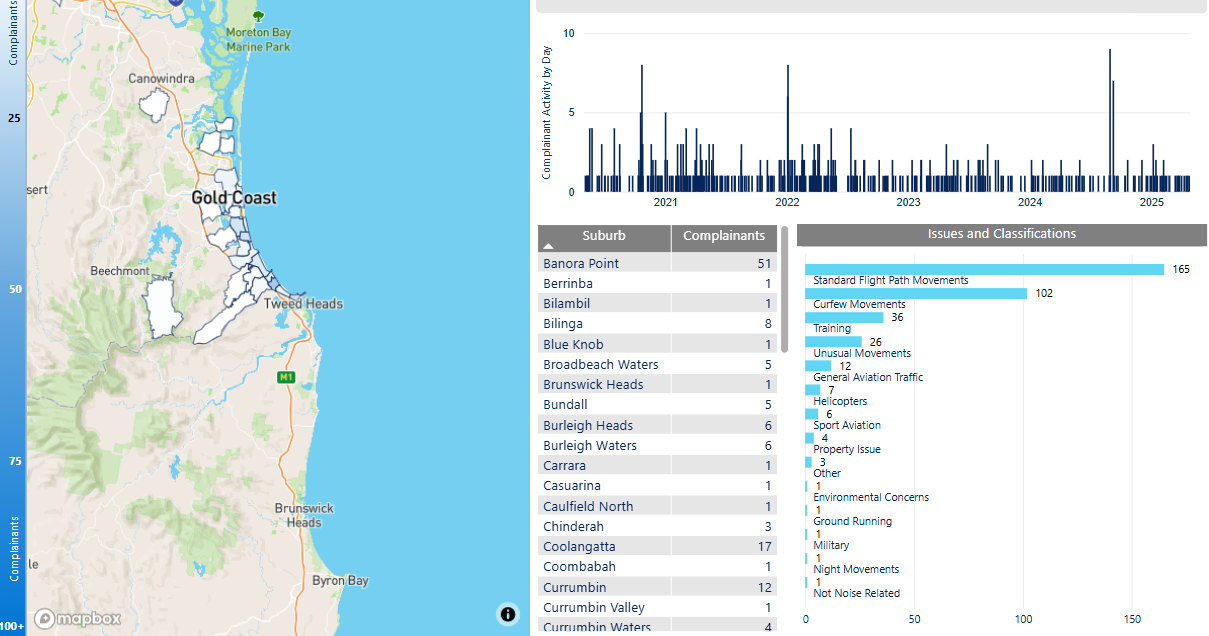
We manage complaints and enquiries about aircraft noise and operations through our Noise Complaints and Information Service (NCIS). The information below is collected for the purpose of complaint management, analysis of issues and identification of causal factors.
For this reason we refer to ‘complainants’ and ‘issues’. Complainants are people who contacted us. While some people submitted enquiries or comments rather than complaints, all are referred to as “complainants”. Issues are the primary concern they raised.
The complaints report
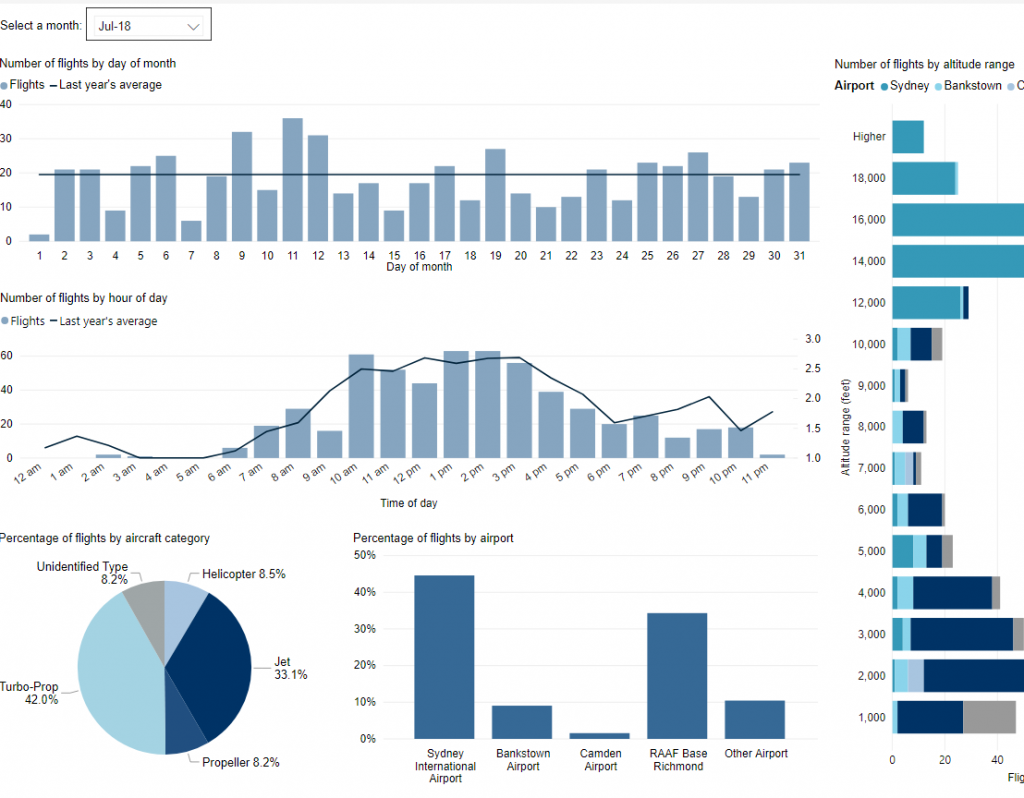
Use this interactive tool to explore the issues raised by residents from different suburbs. For help, click the button in the bottom right-hand corner.
During daylight savings the airport curfew operates on Queensland time with the result that NSW residents can be exposed to aircraft movements until 12 am instead of 11 pm. In 2015, a complainant asked us to investigate whether the preferred runway under the noise abatement procedures could be changed to Runway 32 (rather than Runway 14) between 10 pm and 11 pm Queensland time during daylight saving periods.
Data analysis of movements between 10 pm and 11 pm over three months found that movement numbers were low at this time. There were no movements at all on 33 nights, one movement on 34 nights, two movements on 17 nights, and three to four movements on seven nights.
Comparison of runway usage during the data collection period showed that usage of either runway at this time of year appeared to be almost equally shared, which weakened the case for a change of runway preference.
Because there are approximately three times more arrival movements than departures, for suburbs south of the airport, the proposed change would have a greater negative effect on those areas that are affected by arrival traffic than the positive effect it could have on some areas affected by departure traffic. All these areas south of the airport are in NSW and as such would be on daylight saving time.
The proposal was considered feasible from a safety and efficiency perspective. However, the low number of flights per night in the time period, the fact that many of these are spread between the north and south of the airport, and the fact that the majority of operations are arrivals rather than departures, indicated that any noise improvement would be minimal.
While there might be very small benefits for residents to the south of the Airport that are not overflown by arrival traffic, such as the residents of Fingal Head, this is a small population compared to the area that would either receive no benefit or would experience a worsening of their situation, such as suburbs in NSW under the arrival path and suburbs to the north including Tugun and Currumbin.
On balance, we found that there are insufficient departures between 10.00pm and 11.00 pm during daylight savings periods to outweigh potential negative impacts of the proposed change on other areas and qualify as a noise improvement for the whole community.