

Investigation: Preferred runway under the Noise Abatement Procedures

Perth Airport Noise Abatement Procedures are used by pilots and air traffic control to minimise the impact of aircraft noise on residential areas. The procedures nominate which runways and flight paths are preferred for arriving and departing aircraft. In May 2015 the procedures were amended to accommodate changes to the preferred runway system.

Airservices review of Perth Airport’s noise abatement procedures found the wording on runway preferences did not consistently match the operational requirement of managing the flow of aircraft to and from the airport (in the air and on the ground).

The old procedures specified that Runway 21 (arriving over Guildford) and Runway 24 (arriving over Greenmount) were equally preferred for arrivals and Runway 21 (departing over Queens Park) was the only runway preferred for departures. Arrivals to Runway 06 (over Redcliffe) and departures from Runway 24 (over Redcliffe) were least-preferred due to the close proximity of residential areas at the southern end of the cross runway.

The procedures now give equal preference to arrivals to Runway 21 (over Guildford), Runway 24 (over Greenmount) and Runway 03 (over Queens Park). For departures, equal preference is given to Runway 21 (over Queens Park), Runway 03 (over Guildford) and Runway 06 (over Greenmount). Arrivals to Runway 06 (over Redcliffe) and departures from Runway 24 (over Redcliffe) have been maintained as being least-preferred.

The Post Implementation Review of this change was completed in October 2016 after one year of operations.

Read the Post Implementation Review – Perth Preferred Runways

Read the Terms of Reference for the Post Implementation Review
Investigation: Increased use of north-west RAAF airspace

In May 2013, Airservices permanently implemented an alternative departure procedure from Perth Airport that reduces the number of aircraft flying low over north-western suburbs during the night. The permanent implementation of this procedure follows a trial that started on 27 July 2011 and was known as the ‘Keels trial’.

The new flight path allows some aircraft that previously departed late at night to the north of the airport and then turned towards the coast to make use of RAAF airspace to the north of the airport when the area is not in use by Defence. This change did not apply to all aircraft departing to the north, or change any routes for flights departing to the south.

Previously, most of these aircraft (mostly heading to destinations in the Middle East and Africa) overflew Beechboro and suburbs to the west of Beechboro at between 2500 and 4000 feet (760 to 1200 metres). The new flight path has some of these aircraft take a more northerly route and only turning after they reach 8000 feet (2400m). This additional height reduces the impact of aircraft noise on the ground. It also provides some night-time respite for residents in Beechboro and the suburbs to the west of Beechboro.

Following additional community consultation and environmental assessment, in July 2014 use of this procedure was expanded to all hours when RAAF Pearce airspace is not in use. This will continue to deliver improved noise outcomes for residents living in nearby suburbs including Beechboro, Malaga and Ballajura.

Read the Post Implementation Review of the trial

Noise Complaints and Information Service Report

We manage complaints and enquiries about aircraft noise and operations through our Noise Complaints and Information Service (NCIS). The information below is collected for the purpose of complaint management, analysis of issues and identification of causal factors.

For this reason we refer to ‘complainants’ and ‘issues’. Complainants are people who contacted us. While some people submitted enquiries or comments rather than complaints, all are referred to as “complainants”. Issues are the primary concern they raised.

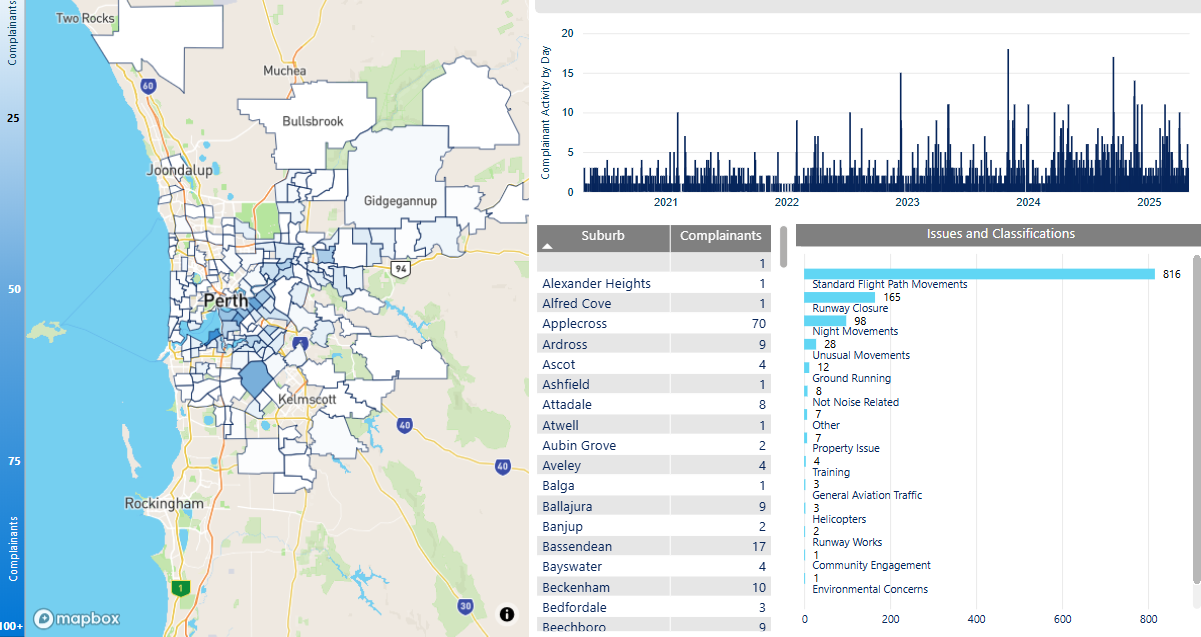
The complaints report

Use this interactive tool to explore the issues raised by residents from different suburbs. For help, click the button in the bottom right-hand corner.

This report is best viewed in full screen mode.

Read an explanation of issues and classifications used in complaint reporting.


How seasonal variation affects your area

Aircraft usually take-off and land into the wind for safety and performance reasons. As the wind direction changes the runway in operation and the flight paths being used may also change.

This means that Perth’s seasonal wind patterns affect usage of the different runway directions. Specifically, Runway 21 tends to be used more frequently in the warmer months due to southerly winds whereas Runway 03 tends to be used more frequently in the cooler months when the predominant wind direction tends to be northerly.

Runways may be used in combination. For example, Runways 03 and 06 may be used at the same time for departures, or Runways 21 and 24 may be used at the same time for arrivals.

As we gather more data on operations we will update this section with more information.


Learn more about how the runway is named and oriented on our Perth Airport Runways page.

Investigation: Proposed night-time respite southern departure path

Airservices proposed a trial to change the flight path for some aircraft departing to the south off Runway 21 at night. The environmental assessment (based on noise modelling) indicated it would not deliver an overall noise improvement. To validate the modelled data used in the environmental assessment, in March and April 2016 Airservices conducted a six-week validation study. Noise monitors were installed at several points along the proposed flight path to obtain baseline noise readings, and then some aircraft were re-routed to use this flight path to collect actual noise level readings. This allowed a direct comparison between actual noise data collected and the modelling data that was used in the environmental assessment.

The study validated the modelling data used in the environmental assessment. As a result that flight path initiative will not be pursued further.

You can read the report here