What was that flight?

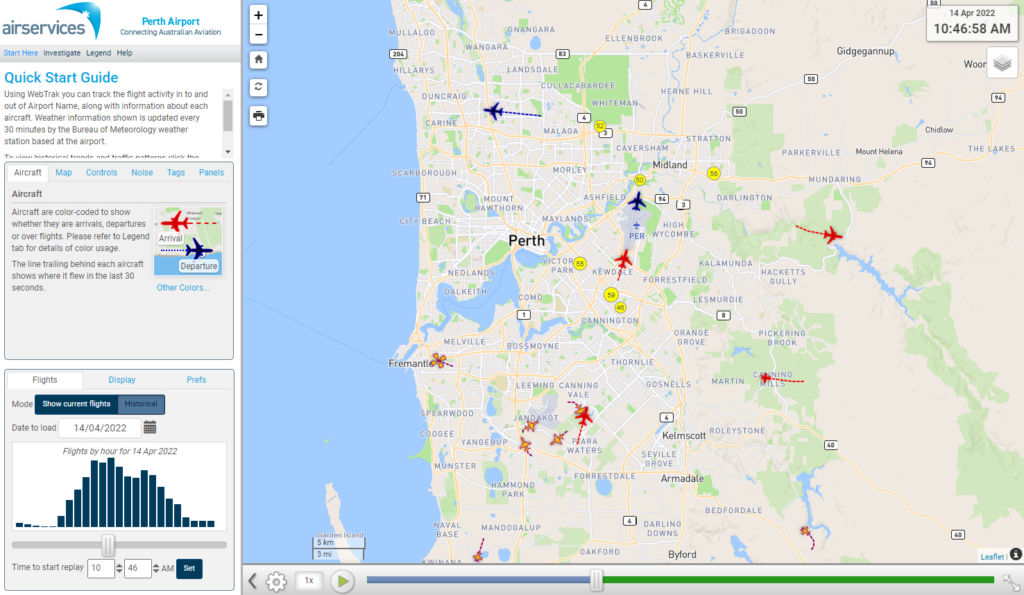
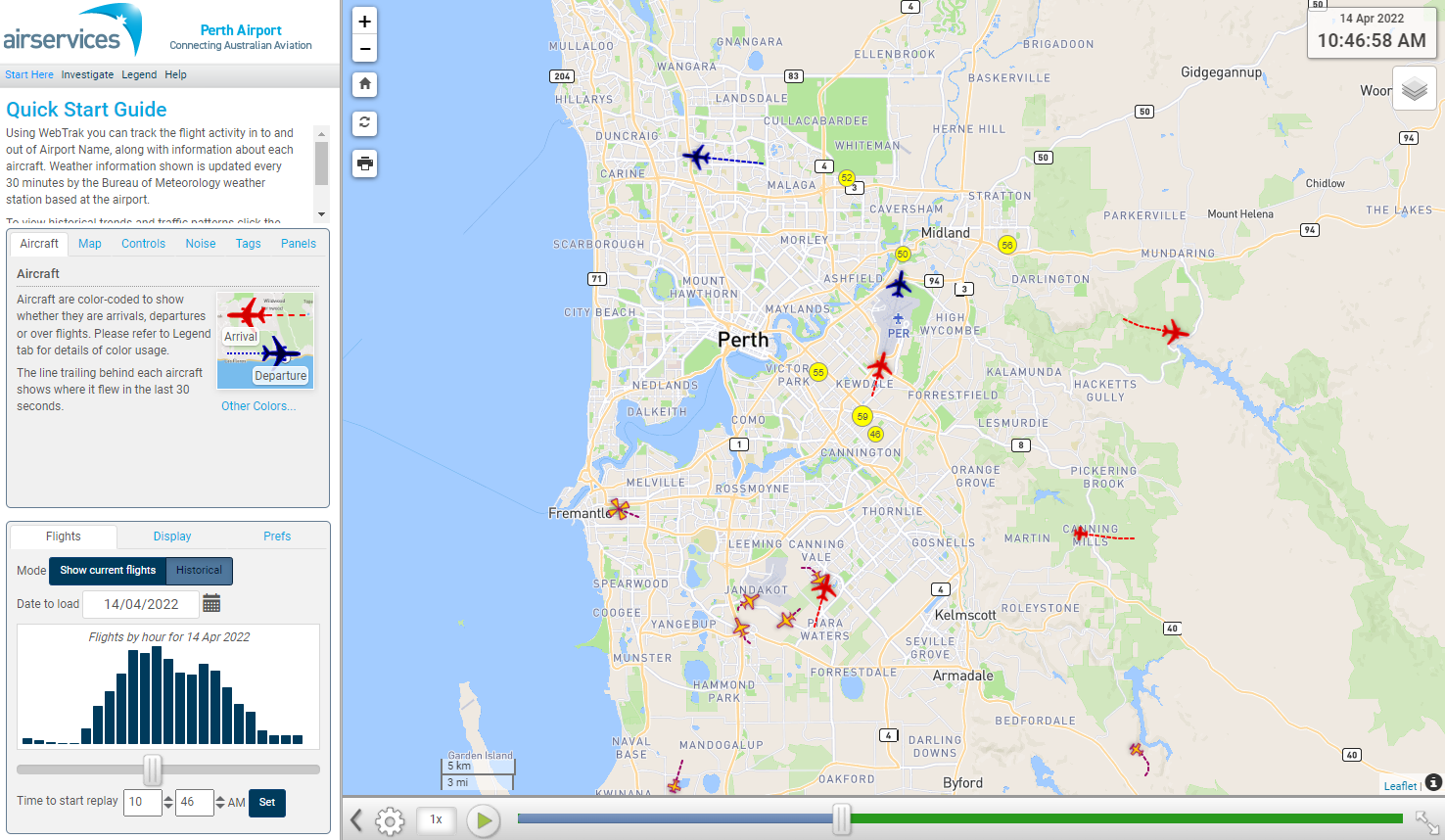
WebTrak is a tool that enables the community to see where aircraft fly and explore historical trends and patterns. WebTrak is provided by Envirosuite.

WebTrak uses information from air traffic control radars to display aircraft movements. The flight search and display function allows you to view aircraft flight activity over metropolitan areas. You can also:

  • locate your street address and have your home appear on the map
  • see noise levels of individual aircraft
  • view information about aircraft type, height, origin and destination
  • display an aircraft’s flight path and point of closest approach to your home
  • zoom in and out down to street level.

Note that there is a slight delay on the display of flights.

You can view WebTrak for your region here.

Or, find out more information about WebTrak and how to use it.

How frequent are flights in my area?

There are a number of factors that influence the frequency of flights.

Firstly, the number and frequency of flights will vary on a daily, weekly and yearly basis due to differences in airline schedules. The airlines schedule flights in response to consumer demand. This is particularly the case around Christmas, Easter, school holidays and Lunar New Year.

Secondly, the runway in use at any given time will also vary, largely due to the wind conditions. Each runway has its own set of flight paths, and each flight path will affect different areas. As the runway in use changes, the flight paths change, and so too do the areas affected by aircraft movements.

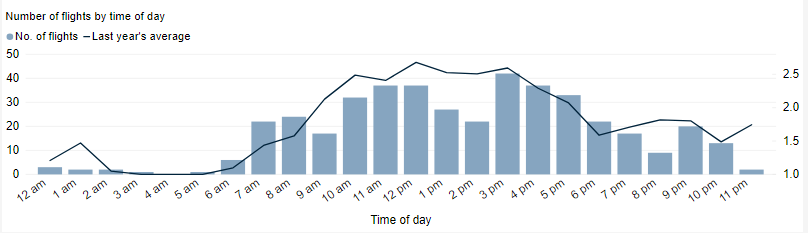
This chart shows the total number of flights each hour over the month, compared to the average for last year. Change the selected month to see how it has varied.

*Please note due to technical issues between 19 June and 22 June 2024, flight data may not be accurately displayed. Our supplier is working to resolve the issue. We apologise for any inconvenience this may cause.

How high are aircraft near me?

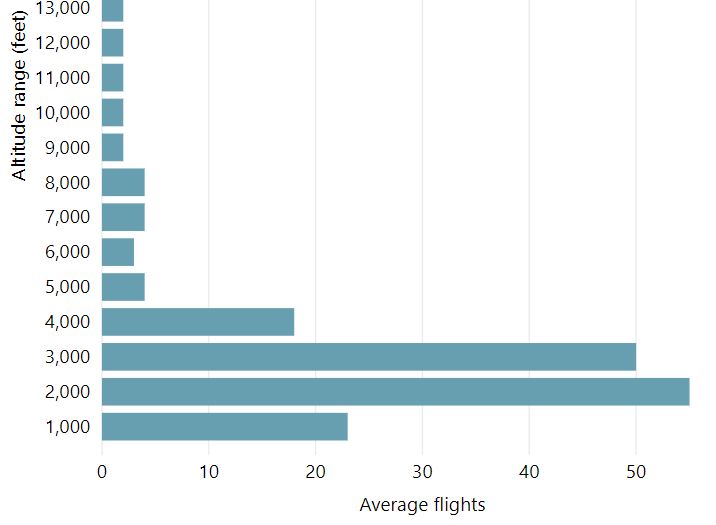
The altitudes of aircraft over your area can vary according to:

  • the airport the flight is coming from or going to
  • whether the aircraft is arriving, departing or in level flight
  • the specific requirements of the flight path
  • the need for air traffic control to maintain vertical separation between aircraft.

Find out more on our What are the rules about altitudes? page.

*Please note due to technical issues between 19 June and 22 June 2024, flight data may not be accurately displayed. Our supplier is working to resolve the issue. We apologise for any inconvenience this may cause.

Explore detailed data for your area

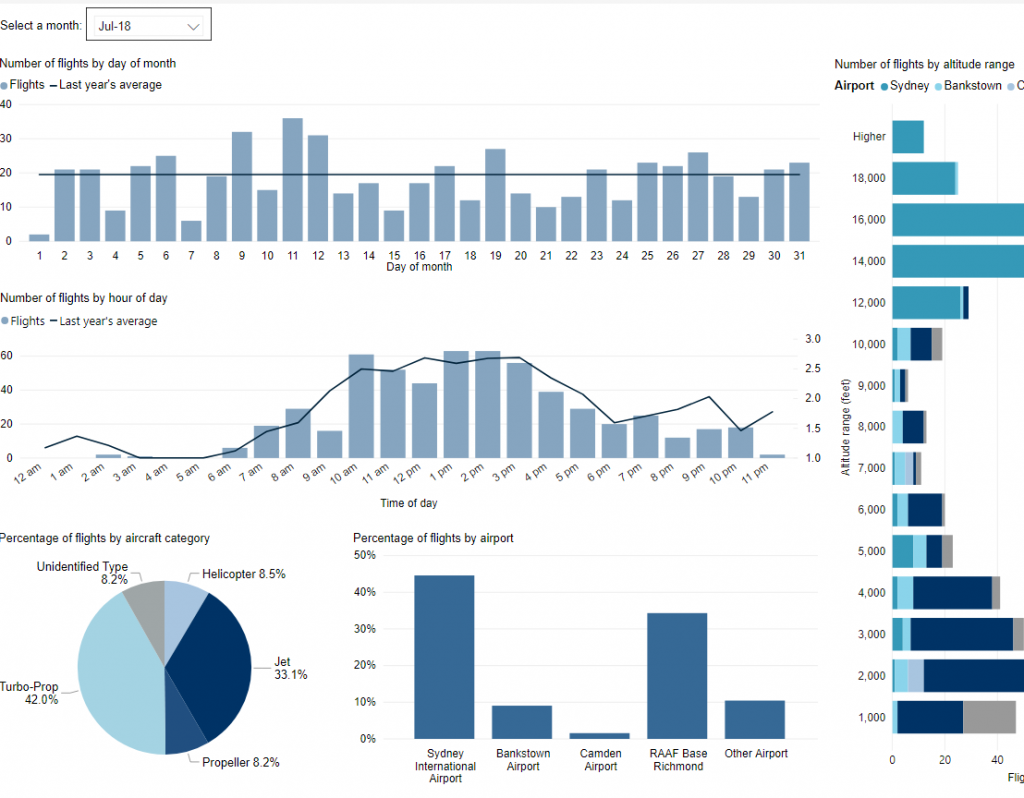
Use this interactive tool to explore detailed data for your area in the month of your choice.

This report is best viewed in full screen mode.

*Please note due to technical issues between 19 June and 22 June 2024, flight data may not be accurately displayed. Our supplier is working to resolve the issue. We apologise for any inconvenience this may cause.

Investigation: Direct tracking to Runways 21 and 24

The practice of direct tracking arrivals to Runways 21 and 24 over Stoneville and Parkerville, northeast of the airport, was addressed. “Direct tracking” involves taking an aircraft off the standard flight path and giving it a shorter route. This now only occurs when it is operationally required, for example, for traffic management reasons to ensure separation is maintained.

Investigation: Eastern departures to maintain 8000 feet

Noise Abatement Procedures at Perth allow aircraft to be taken off Standard Instrument Departure (SID) procedure tracking once jets are at 5000 feet above ground level and non-jets 3000 feet except where impractical in the normal course of operation to and from the runways. This provision is primarily in place to assist the efficient management of aircraft close to the airport during peak periods.

In response to community concerns about the minimum height of aircraft over residential areas, Airservices held a trial from December 2013 to February 2014 for all aircraft flying to the east of Perth to maintain SID tracking until leaving 8000 feet except where required for operational reasons.

A Post Implementation Review of the trial was completed in December 2014. While community feedback was limited, Airservices concluded there was a noticeable benefit from the trial and that the change should be permanently implemented in Perth Airport’s Noise Abatement Procedures. This change was permanently implemented on 28 May 2015.

Investigation: Roleystone – modified flight path

Airservices identified an opportunity to modify the flight path for aircraft arriving from the north to land on the southern end of the Runway 03 at Perth Airport which would move aircraft away from Bickley, Byford, Carmel, Martin and Roleystone and closer to Bickley East, Karragullen and Pickering Brook which had smaller populations.

Post Implementation Review of the trial was published in February 2015. The review found that community feedback demonstrated a noticeable benefit had been achieved from the trial and that as a result the change should become permanently implemented. Airservices actioned this on 5 March 2015.

Investigation: Moving the converging point for eastern arrivals to Runway 03

Arriving aircraft from the east that are making an instrument approach to Runway 03 (long straight-in approach to the southern end of the main runway) converged at a point near Bedfordale. Airservices proposed to move this converging point some 8-10 kilometres to the east to reduce the number of aircraft impacting the Bedfordale area. This change came into effect on 5 March 2015.

When is each flight path used?

Flight paths are not precise, defined paths like runways, but more like corridors that are often several kilometres wide.

Arrivals

Jet arrivals into Perth are generally aligned with the runway at least ten kilometres from the airport. From this point they will fly towards the runway in a straight line. This means that suburbs in line with the runways are overflown by arriving jets. Other suburbs may be overflown by aircraft proceeding towards the point at which they join the final approach and align with the runway.

Runways 03, 21 and 24 have Instrument Landing Systems. This type of approach requires aircraft to be at around 3000 feet when they begin their approach. Aircraft will descend steadily to the runway using the horizontal and vertical guidance provided by the system.

There is no minimum altitude for aircraft in process of landing. Aircraft will generally descend on a glide slope of three degrees.

A growing number of modern aircraft are now fitted with navigation systems that use satellite-assisted guidance which allow aircraft to fly with a higher degree of accuracy and more closely follow the same route as other aircraft. Airservices refers to these routes as Smart Tracking. Smart Tracking technology makes air travel safer, cleaner and more dependable. It also has the potential to improve noise outcomes for communities living close to airports. A Smart Tracking approach was implemented to Runway 03 in 2015.

Departures

Departure flight paths allow aircraft to maintain the runway heading for a short time until they are stabilised in flight, and then to turn towards the route that will take them to their destination.

Around 60 per cent of all departures from Perth Airport depart to the south from Runway 21. Nearly two-thirds of this 60 per cent are heading for the eastern states and international ports such as New Zealand. These flights will turn left (east) from Runway 21. Around 40 per cent of this 60 per cent are aircraft heading for destinations to the west, north and north-west such as South Africa, the Middle East, Asia, Karratha, Paraburdoo and Port Hedland. These aircraft will turn right (west) after departure from Runway 21.

When Runway 03 is in use aircraft with westerly and northerly destinations will turn left. Some will continue northwards if military airspace is not active. Runway 03 is often used in combination with Runway 06, that is, both runways will be in use for departures at the one time. This means that air traffic controllers can only turn aircraft departing from Runway 03 right if it will not conflict with traffic departing Runway 06. When Runway 06 is used for departures, most of the domestic traffic to the eastern states will use that runway which minimises the need for aircraft to turn right from Runway 03.

The altitude of aircraft after departure will depend on factors such as the type of aircraft and its weight, how heavily laden it is with fuel and passengers, and the atmospheric conditions at the time. All these factors affect an aircraft’s climb rate. There is no regulated minimum altitude for an aircraft in the process of taking off.

Flight path information

You can access historical information about flight path use through WebTrak. To access this information click the “Historical” link below the text in the Quick Start Guide at the top left-hand side of the screen. Then use the tick boxes at the bottom-right of the screen to select monthly, quarterly or yearly information. Use the sliders to refine your selection to specific timeframes.

Will flights increase in the future in my area?

Flight Path and Airspace Changes

Visit Engage Airservices to engage with our program of flight path and airspace changes.

Airport Master Plans

Airport Master Plans provide a blueprint for the future development of an airport over a twenty year period. They include information on forecast growth, airport terminals and facilities, runways and flight paths.

Who is responsible for master planning?

Airports are responsible for producing the master plan.

Perth Airport

The Perth Airport Master Plan can be found on the Perth Airport website.

Jandakot Airport

The Jandakot Airport Master Plan can be found on the Jandakot Airport website.