Hobart Airport Flight Paths

Hobart Airport has a number of flight paths from its runway.

To learn more about the runway at Hobart Airport, take a look at our Hobart Airport Runway page.

The illustration below shows how jet and non-jet (turbo-prop) aircraft typically operate at Hobart Airport on the published instrument arrival and departure flight paths.

The animation is indicative only and provided for information purposes, on occasions flights may leave these general areas from time-to-time.

Cambridge Airport circuits

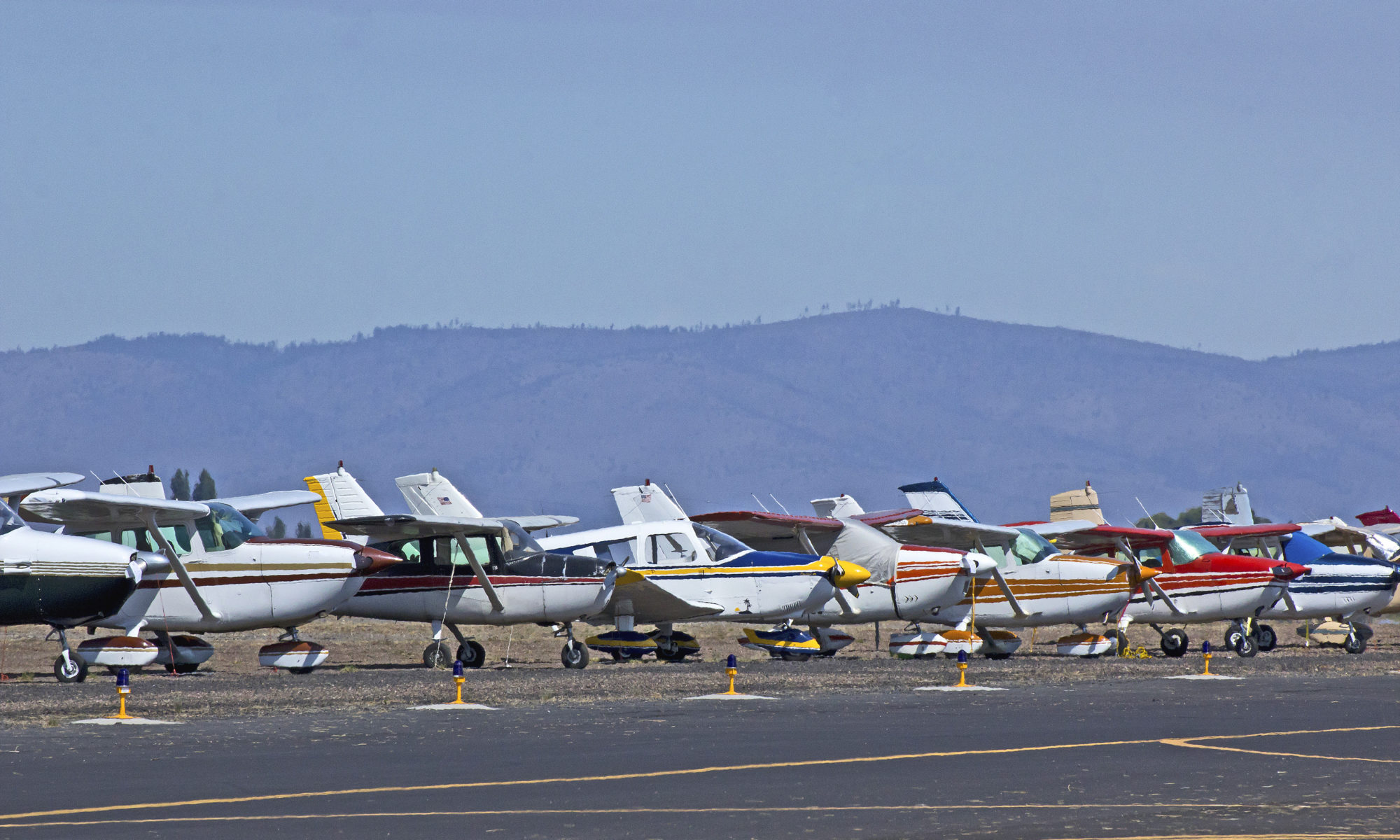
The majority of General Aviation (light aircraft) operations are conducted to or from Cambridge Aerodrome.

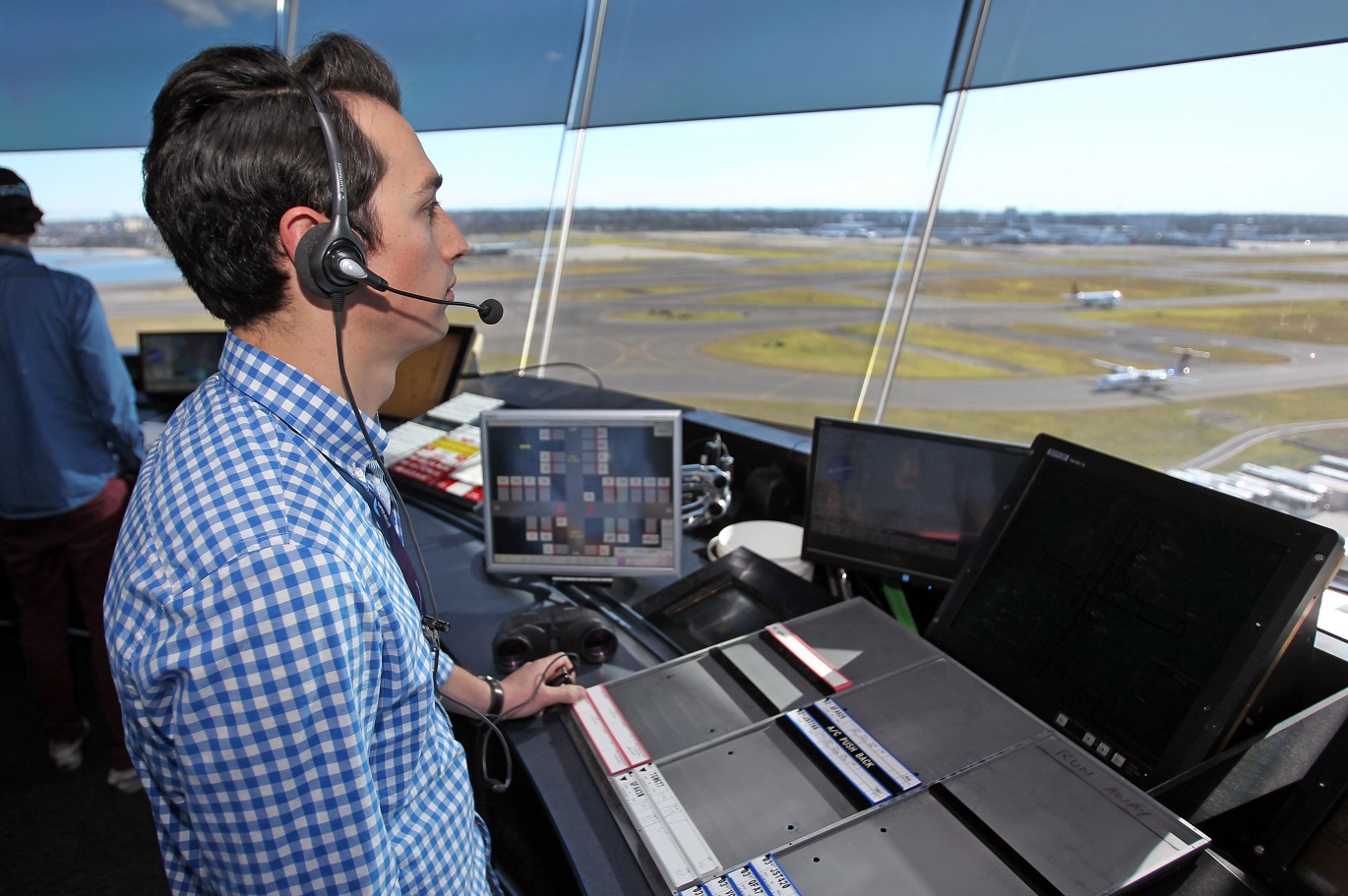
Air traffic control do not provide runway separation or information on traffic operating on the manoeuvring area to Cambridge Aerodrome, however, during tower hours (5:50am to 10:10pm) Hobart Tower provides information for Cambridge aerodrome traffic.

Rotor-Lift Aviation also conduct circuit training at Hobart Airport and winch training at Seven Mile Beach and at Pawleena. 

To learn more about Cambridge Airport operations, take a look at our Cambridge Airport Flight Paths page.

Where are the circuits at Hobart?

By day most of the circuit training is conducted on the west of the aerodrome over the suburbs of Cambridge, Mount Rumney and Acton Park, while at night it is done to the eastern side of the aerodrome over Hobart airport and Barilla Bay. Regular use is also made of the Ralphs Bay Flying Training area adjacent to the suburbs south of Lauderdale.

General aviation traffic operating beyond the Cambridge circuit are not constrained to set routes however geographical limitations, preferred operating routes and the need to segregate these operations from jet traffic means that there tends to be a higher concentration of aircraft operating to and from the Hobart City area to the west and to from the Midway Point/ Sorrell areas to the East (and beyond).

What is circuit training?

Circuit training is the first stage of practical pilot training focused on take-offs and landings. It involves the pilot making approaches to the runway or helipad, touching down and then applying power to take off again. This is undertaken in accordance with Civil Aviation Safety Authority (CASA) Regulations which are consistent with international practices.

How are circuits flown?

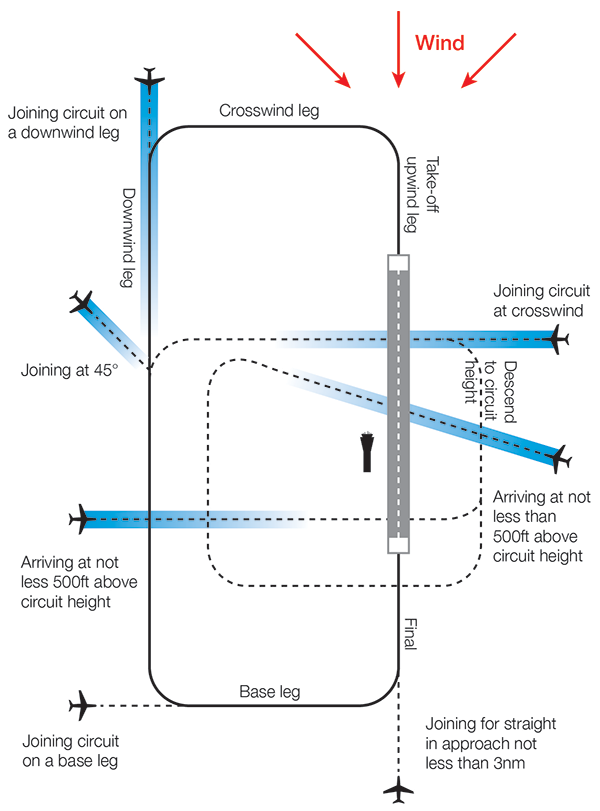
A training circuit consists of five legs – take-off, crosswind, downwind, base and final approach to the runway.

Aircraft take off into the wind, climb to 500 feet and then turn onto the crosswind leg. They continue to ascend to 1000 feet and turn onto the downwind leg. Having turned onto the base leg the descent commences. After turning onto the final leg and lining up with the runway the aircraft will touch down and take off again.

For left-hand circuits, the pilot turns left after take-off and flies anticlockwise. For right-hand circuits, the pilot turns right and flies in a clockwise direction.

A simplified representation of a left-hand circuit is shown above

When is each flight path used?

Air traffic control manage the traffic to each runway at an airport using a range of operations which can include clearing aircraft to use published flight paths, issuing visual approaches or vectoring for separation and sequencing. As the runway in use changes, the types of operations in use will also change, and so different suburbs and areas are affected by aircraft movements.

Flight paths do not operate in isolation. They are part of an interconnected network. Flight paths need to accommodate aircraft operating constraints, provide terrain clearance and fit into the overall airspace design.

Flight paths at Hobart Airport are designed as standardised tracks that segregate arriving aircraft from departing aircraft.

Arrivals

Jet arrivals into Hobart Airport are generally aligned with the runway approximately 10 kilometres from the runway. From this point, they fly towards the runway in a straight line. This means suburbs and towns in line with the runway are overflown by arriving aircraft. Other suburbs and towns may be overflown by aircraft travelling to join the final approach to align with the runway.

There are two approach paths for each end of the runway, which are used depending on the technology available on-board arriving aircraft. Aircraft can either join the final approach path closer to the airport or, if they do not have the required technology, they can join it approximately 15-18 kilometres from the runway.

The altitude the aircraft will be at when it begins its final approach will depend on the remaining distance of flight to the runway. There is a regulated minimum altitude for aircraft at all stages of arrival that is determined by the height of terrain in the vicinity of the aircraft, however aircraft are usually well above this minimum altitude. Aircraft will generally descend on a glide slope of three degrees.

Departures

Departure flight paths allow aircraft to maintain the runway heading for a short time until they are stabilised in flight, before heading to their destinations. Departure paths also take into consideration any arrival paths or other departure paths that may need to be crossed.

There are separate departure paths for jets and non-jets at Hobart Airport. Jet departures continue straight ahead in their take-off direction for at least 13km before turning. Non-jets are turned off towards their headings sooner after departure. The purpose of non-jets turning sooner aims to make separation and traffic management simpler for air traffic control and improve airport efficiency.

The altitude of aircraft after departure depends on factors, including wind direction and speed, temperature, air pressure, aircraft type and aircraft weight (this can vary depending on passenger numbers and fuel load). All these factors affect an aircraft’s climb rate. There are regulated minimum altitudes (based on terrain heights in the vicinity of flight paths) for aircraft departing a runway, however performance of modern aircraft usually result in aircraft being much higher than minimum regulated altitudes. Aircraft taking off generally climb at a higher gradient than aircraft landing. Minimum altitudes are governed by international standards.


Learn more about how the runway is used on our Hobart Airport Runway page.

Will flights increase in the future in my area?

Flight Path and Airspace Changes

Visit Engage Airservices to engage with our program of flight path and airspace changes.

Hobart Airspace Design Review – Post Implementation Review

On 7 November 2019, Airservices introduced new instrument flight procedures and flight paths at Hobart Airport. As these flight paths have been in operation for over 12 months, we have commenced a Post Implementation Review (PIR) and are accepting community suggested alternatives for flight paths and Noise Abatement Procedures (NAPS).

For more information, including how to participate in the Review visit Engage Airservices.

Airport Master Plans

Airport Master Plans provide a blueprint for the future development of an airport over a twenty year period. They include information on forecast growth, airport terminals and facilities, runways and flight paths.

Who is responsible for master planning?

Airports are responsible for producing the master plan.

Hobart Airport

The Hobart Airport Master Plan can be found on the Hobart Airport website.

Noise Complaints and Information Service Report

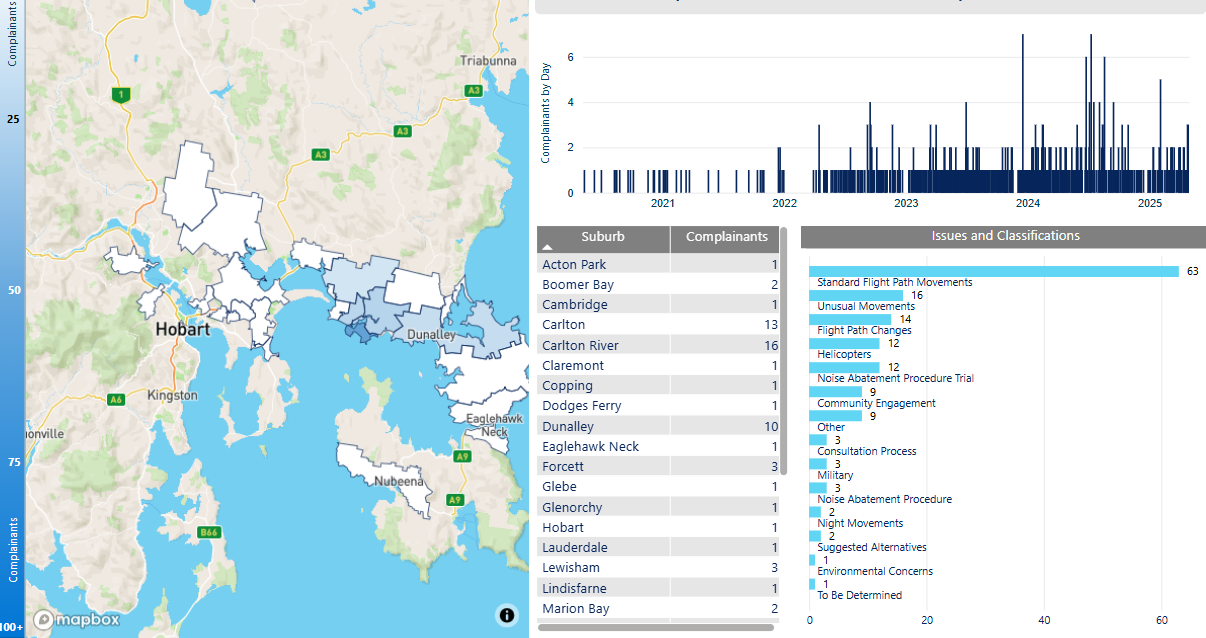
We manage complaints and enquiries about aircraft noise and operations through our Noise Complaints and Information Service (NCIS). The information below is collected for the purpose of complaint management, analysis of issues and identification of causal factors.

For this reason we refer to ‘complainants’ and ‘issues’. Complainants are people who contacted us. While some people submitted enquiries or comments rather than complaints, all are referred to as “complainants”. Issues are the primary concern they raised.

The complaints report

Use this interactive tool to explore the issues raised by residents from different suburbs. For help, click the button in the bottom right-hand corner.

This report is best viewed in full screen mode.

Read an explanation of issues and classifications used in complaint reporting.

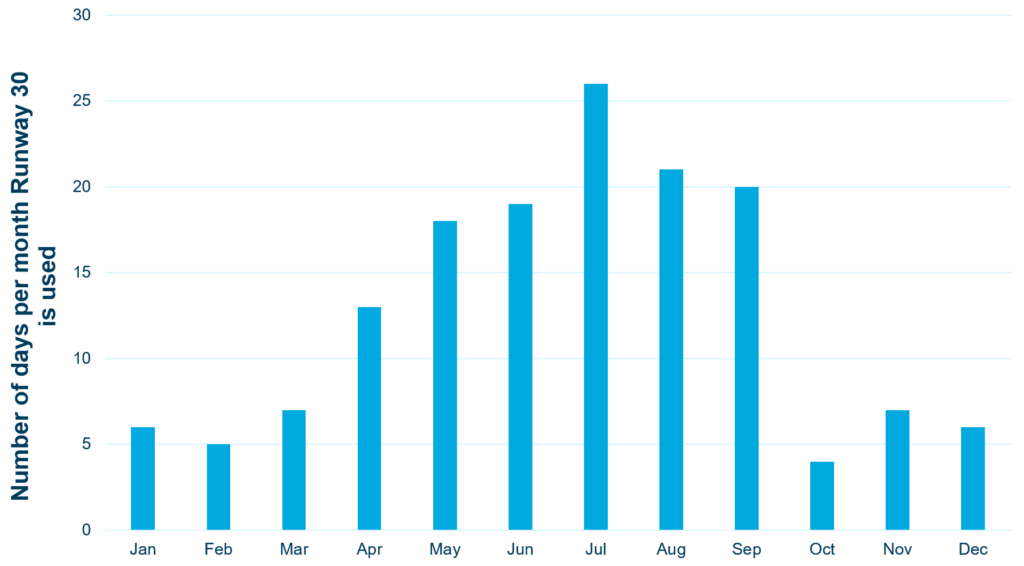
How seasonal variation affects your area

Aircraft usually take-off and land into the wind for safety and performance reasons. As the wind direction changes, the runway in operation and the flight paths being used may also change.

This means that Hobart’s seasonal wind patterns affect usage of the different runway directions.

Summer

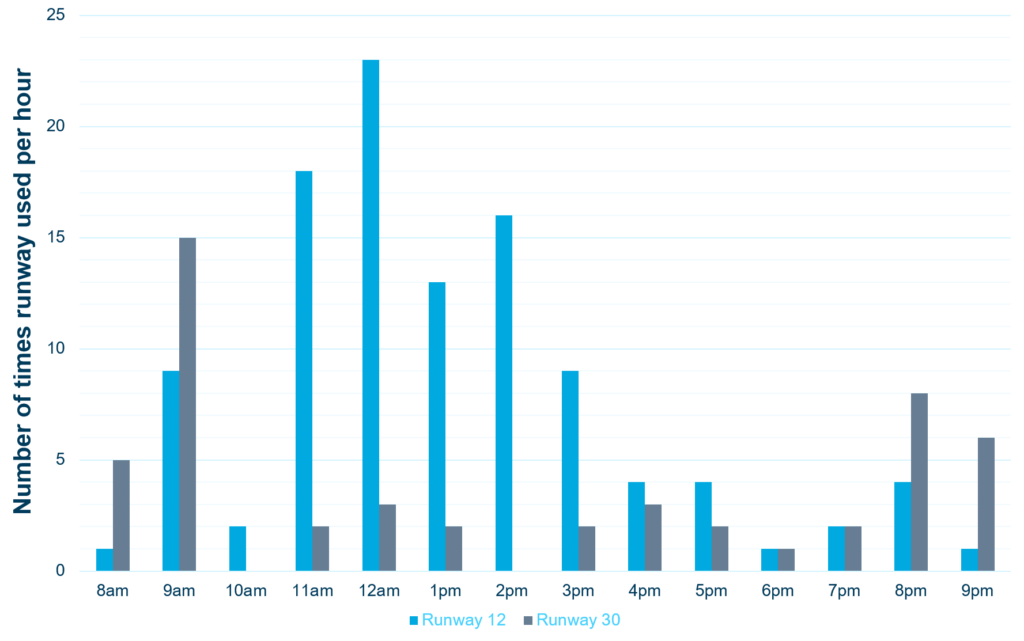
During summer, when afternoon sea-breezes are common, the wind varies so both Runway 12 and Runway 30 are used.

Runway 30 is mostly used in the morning (8-9am) and evening (8-9pm) and Runway 12 is mostly used during the day (10am-5pm).

The flight paths in use change depending on the runway being used.

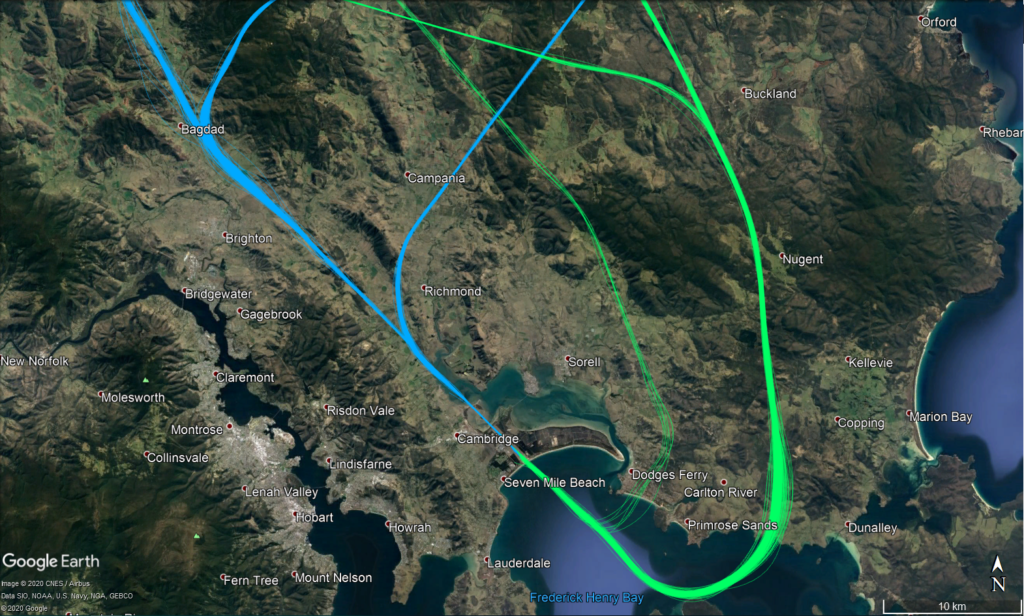
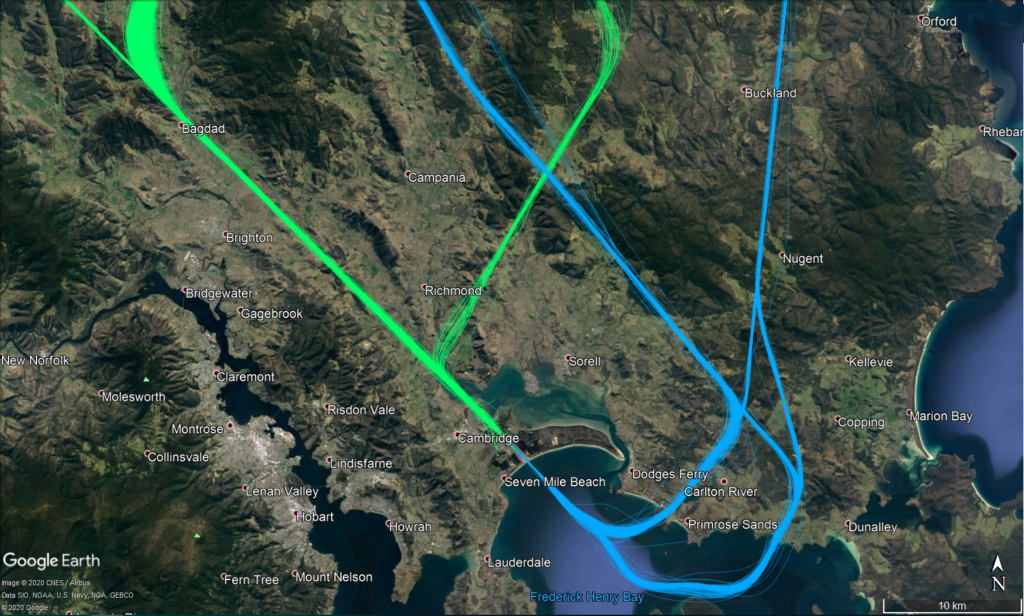
Runway 12 Typical Usage, Arrivals (Blue), Departures (Green)

When Runway 12 is used, aircraft depart to the south before turning north and crossing the coast near Connellys Marsh (jets) or Dodges Ferry/Carlton (non-jets). Aircraft arrive from the north using two approach paths (depending on the technology available on-board the aircraft) near Campania or Bagdad.

Runway 30 Typical Usage, Arrivals (Blue), Departures (Green)

When Runway 30 is used, aircraft depart to the north before turning near Bagdad (jets) or Richmond (non-jets). Aircraft arrive from the south using two approach paths (depending on the technology available on-board the aircraft), crossing the coast near Carlton/Primrose Sands or Connellys Marsh.

Most of the year

The prevailing wind is north-westerly for most of the year (approximately 75% of the year), meaning that Runway 30 is used most frequently.

The flight paths in use are most often those for Runway 30.

Runway 30 Typical Usage, Arrivals (Blue), Departures (Green)

When Runway 30 is used, aircraft depart to the north before turning near Bagdad (jets) or Richmond (non-jets). Aircraft arrive from the south using two approach paths (depending on the technology available on-board the aircraft), crossing the coast near Carlton/Primrose Sands or Connellys Marsh.


Learn more about how aircraft arrive to Hobart Airport on our When is each flight path used? page.

Note: All tracks have been displayed. Track colours have been adjusted to show track density. Where aircraft are more concentrated the colour will appear darker.