Learn about flight paths and aircraft movements in your area
Welcome to the Aircraft in Your Neighborhood Portal
Our goal is that you will learn more about the flight paths and aircraft movements in your area and be able to access the information and resources that explain how air traffic is managed.
First, please select your location using one of the following options, so that we can customize the information for your location.
We’ll remember your location so you don’t have to enter it every time you visit the site and we’ll keep this information confidential.
Please note, that this site works best on Chrome, Firefox and Edge.
* Mandatory - Select region first to view the map.
Aircraft usually take-off and land into the wind for safety and performance reasons. As the wind direction changes the runway in operation and the flight paths being used may also change.
This means that the Sunshine Coasts seasonal wind patterns affect usage of the different runway directions.
When there are easterly or southerly winds, aircraft approach the runway from an inland direction and depart towards the ocean.
When the wind is from a westerly or northerly direction, the runway is used in the opposite direction.
If the wind is light or calm the direction the runway is used is determined by other factors such as Noise Abatement Procedures (NAP) or air traffic management requirements.
As we gather more data on operations we will update this section with more information.
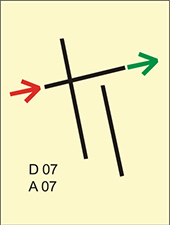
During non-peak periods for Sydney Airport a noise sharing mode will be used whenever possible. Therefore during these periods you are more likely to experience aircraft noise from aircraft arriving or departing the east-west runway than at other times of the day.
While it depends on the flights scheduled for the day, non-peak periods are generally:
6am to 7am
11am to 3pm
8pm until 11pm
The parallel runways are always used during peak periods for the airport (generally 7am to 11am and 3pm to 8pm, depending on airline schedules). Whenever possible, noise sharing is conducted at other times in order to give residents affected by use of the parallel runways a break.
Find out how frequently noise sharing modes are used with our interactive monthly Sydney Airport Operational Statistics tool, available in the resources section.
Precision Radar Monitor (PRM) is a technique used in poor weather to ensure safe and efficient operations at Sydney Airport. PRM can only be used in weekday morning peak periods, that is, between 7am and 11am, Monday to Friday.
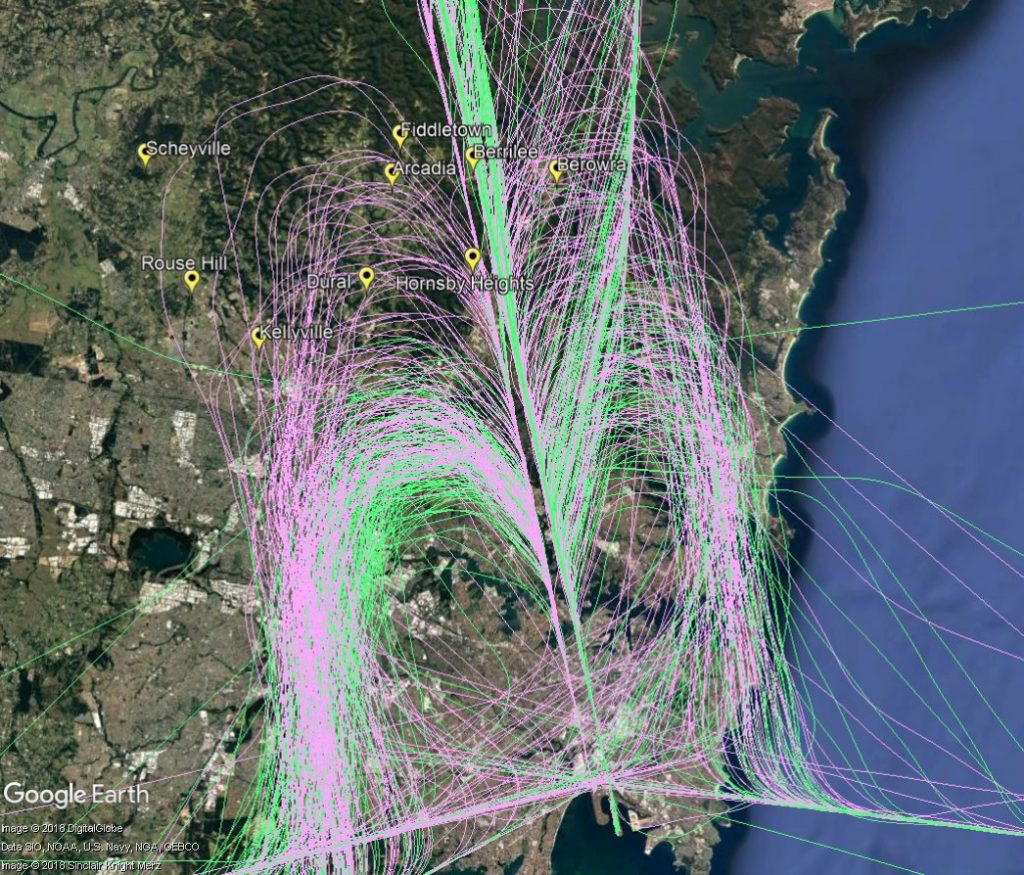
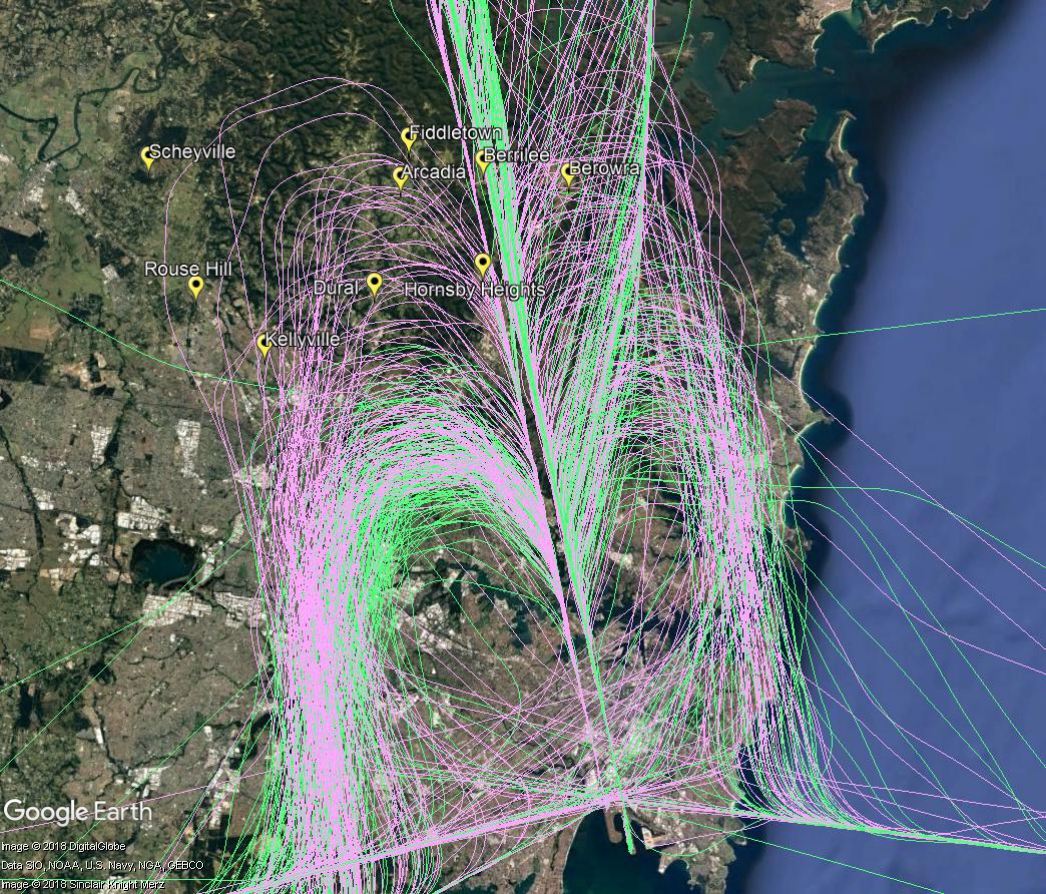
An effect of PRM operations is that aircraft are required to align with the runway five to ten kilometres further north of the airport. These aircraft will overfly suburbs and townships to the north-west and north of Sydney that do not usually experience overflight from arriving aircraft, such as Kellyville, Dural, Hornsby Heights, Arcadia and Fiddletown. Other areas that are already overflown by arrivals, such as Cherrybrook, Hornsby, Berrilee and Berowra, will experience more traffic when PRM is in use.
The following image of actual aircraft tracks illustrates this. The green tracks are aircraft making approaches at times when PRM is not being used. The pink tracks are flights during PRM operations.
The east-west runway tends to be used more frequently for arrivals from the east in the cooler months than at other times of the year. This means that you are more likely to notice aircraft arriving over your area to land on the east-west runway in autumn and winter.
It is relatively unusual for aircraft to depart towards the east from the east-west runway but it does occur on occasion when the wind is a strong easterly. When this occurs it means the crosswind limit has been exceeded on the parallel runways and they cannot be safely used. When all traffic has to use the east-west runway it usually results in delays at the airport and knock-on effects around the country.
In 2016 departures towards the east occurred on six days (in February, March, June, October and November), and in 2017 and 2018 occurred on one day each year (in October and November respectively).
The east-west runway tends to be used more frequently for arrivals from the west in the warmer months than at other times of the year because there are usually more easterly winds. This means that you are more likely to notice aircraft arriving to the east-west runway over your area in spring and summer.
The east-west runway tends to be used more frequently for departures towards the west in the cooler months than at other times of the year because there are usually more westerly winds. This means that you are more likely to notice aircraft departing from the east-west runway over your area in autumn and winter.
During non-daylight saving periods you may notice some aircraft arriving in the early morning between 5.00am and 6.00am.
While the curfew ends at 6.00am, under the curfew regulations the Department of Infrastructure, Transport, Cities and Regional Development may permit a limited number of passenger flights to land between 5.00am and 6.00am during non-daylight-saving periods. When daylight saving is in place these flights arrive after the curfew ends at 6.00am, but when clocks are turned back at the end of daylight saving they arrive an hour earlier. These flights generally originate from ports where curfews prevent them leaving later.
These early morning flights are required to land from the south, over the water. However they may fly over land as they travel to cross the coast and join the final approach.
An arrival burst of long-haul international flights tends to occur just after the curfew ends at 6am.
Heavy jets, especially those flying long-haul routes, require the use of the westernmost parallel runway for landing, (Runway 16 Right), because it is the longest runway. The extra length is needed for a safe landing. For this reason residents in suburbs around the flight path to this runway are likely to notice increased movements in the hour immediately after the curfew.
A departure burst of long-haul international flights tends to occur in the last two hours before the Sydney Airport curfew begins.
Heavy jets, especially those flying long-haul routes, require the use of the westernmost parallel runway (Runway 34 Left) because it is the longest runway. The extra length is needed for a safe take-off. For this reason residents in suburbs under flight paths from this runway are likely to notice increased movements in the hour before the curfew.
You may notice that these heavily laden jets tend to climb more slowly than lighter aircraft.
Aircraft usually take-off and land into the wind for safety and performance reasons. As the wind direction changes, the runway in operation and the flight paths being used may also change.
This means that Hobart’s seasonal wind patterns affect usage of the different runway directions.
Summer
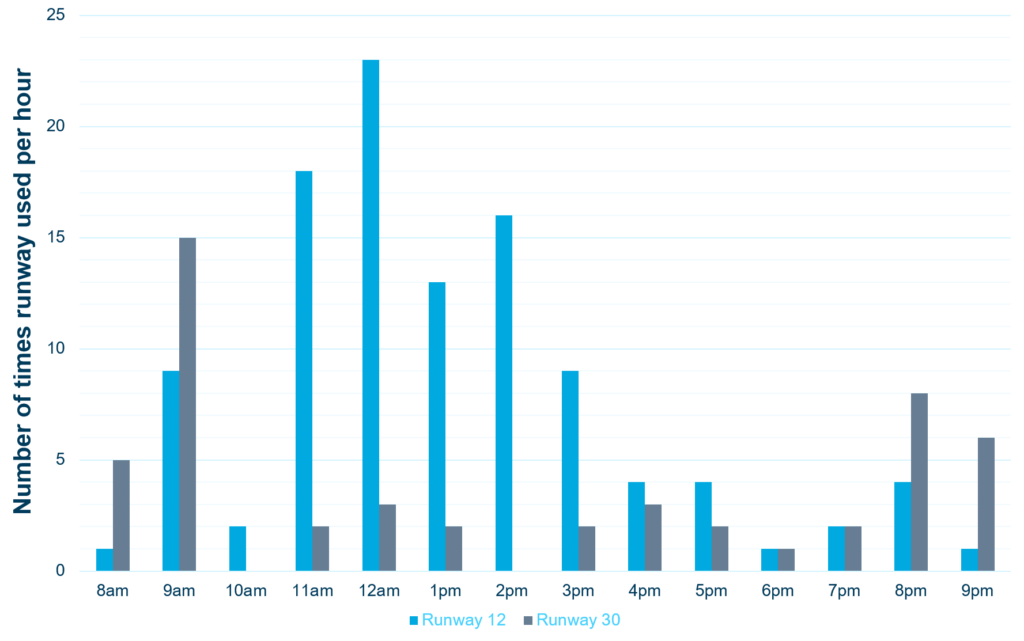
During summer, when afternoon sea-breezes are common, the wind varies so both Runway 12 and Runway 30 are used.
Runway 30 is mostly used in the morning (8-9am) and evening (8-9pm) and Runway 12 is mostly used during the day (10am-5pm).
The flight paths in use change depending on the runway being used.
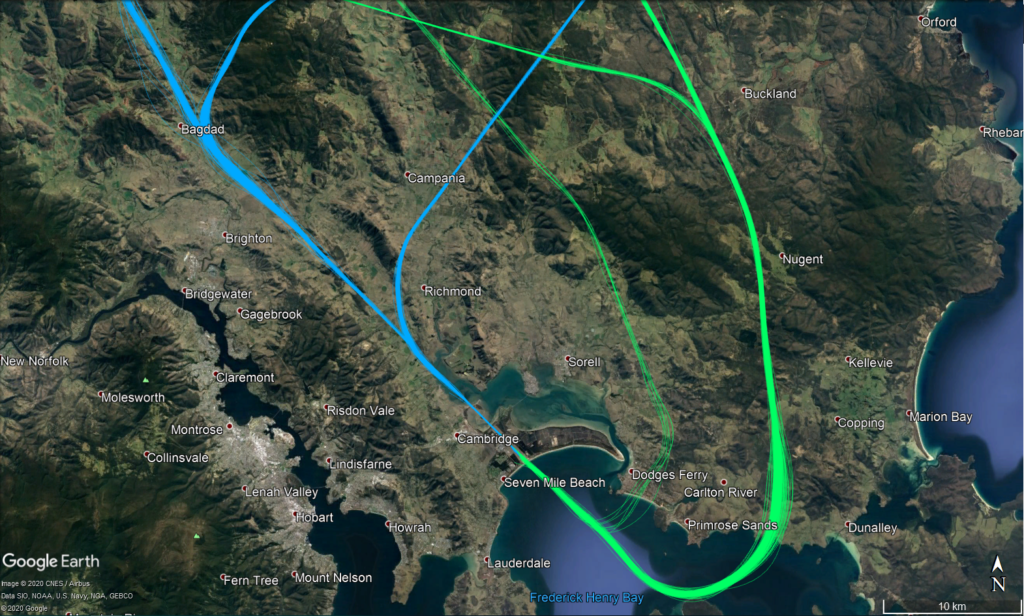
When Runway 12 is used, aircraft depart to the south before turning north and crossing the coast near Connellys Marsh (jets) or Dodges Ferry/Carlton (non-jets). Aircraft arrive from the north using two approach paths (depending on the technology available on-board the aircraft) near Campania or Bagdad.
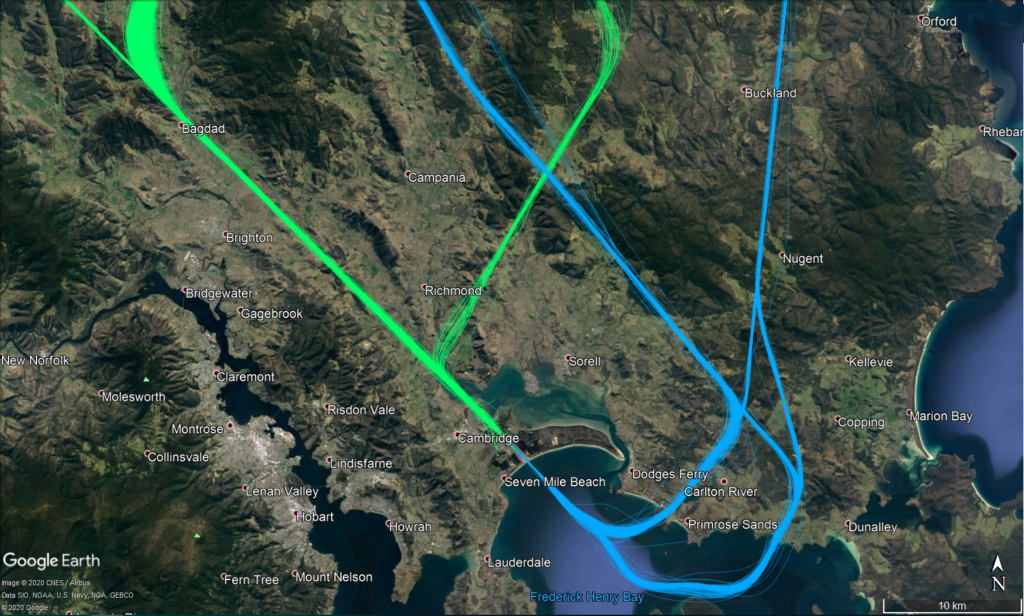
When Runway 30 is used, aircraft depart to the north before turning near Bagdad (jets) or Richmond (non-jets). Aircraft arrive from the south using two approach paths (depending on the technology available on-board the aircraft), crossing the coast near Carlton/Primrose Sands or Connellys Marsh.
Most of the year
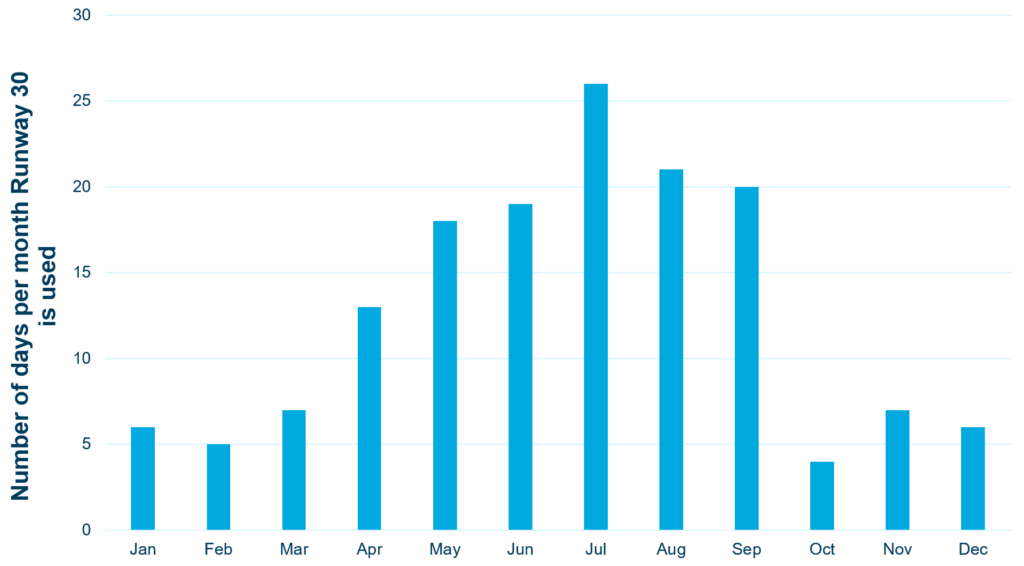
The prevailing wind is north-westerly for most of the year (approximately 75% of the year), meaning that Runway 30 is used most frequently.
The flight paths in use are most often those for Runway 30.
When Runway 30 is used, aircraft depart to the north before turning near Bagdad (jets) or Richmond (non-jets). Aircraft arrive from the south using two approach paths (depending on the technology available on-board the aircraft), crossing the coast near Carlton/Primrose Sands or Connellys Marsh.
Note: All tracks have been displayed. Track colours have been adjusted to show track density. Where aircraft are more concentrated the colour will appear darker.