
Sunshine Coast noise abatement and fly neighbourly

Noise Abatement Procedures

Every major airport has Noise Abatement Procedures (NAPs), which are procedures designed to reduce the impact of aircraft noise on the community. There are some limitations to the use of NAPs and they may not be used if they generate delay and congestion, as this can cause noise and emission impacts. Air traffic control or pilots may not be able to use them in certain situations, for example weather conditions or operational requirements. 

Under the NAPs, the preferred runway for jet aircraft at Sunshine Coast Airport is Runway 31 for landing and Runway 13 for take-off.

During the operating hours of the air traffic control tower, controllers will determine the runway direction in accordance with operational requirements and other factors, such as the NAP.

When the tower is closed, the pilot will determine the best runway to use and will take consideration of any request by airport management. When operationally possible to do so, they will also apply the NAP.

The NAPs also specify that aircraft above 5,700 kilograms in weight, should track via approved flight paths when arriving and departing the airport.

Between the hours of 11pm and 5:30am, aircraft above 5,700 kilograms require prior approval from Sunshine Coast Airport to land or take-off from the airport.

Aircraft below this weight do not require prior approval and are permitted to operate at any time. 

Further information on overnight operations, including reports, can be found on the Sunshine Coast Airport website.

Fly Neighbourly Agreements

Fly Neighbourly Advice or Fly Neighbourly Agreements are voluntary agreements established between aircraft operators and communities or authorities (normally airports or local councils) to assist in reducing the impact of aircraft noise on local communities. Sunshine Coast Airport has a voluntary Fly Neighbourly Program which encourages pilots to fly in a noise sensitive way whenever possible.
Noise Complaints and Information Service Report

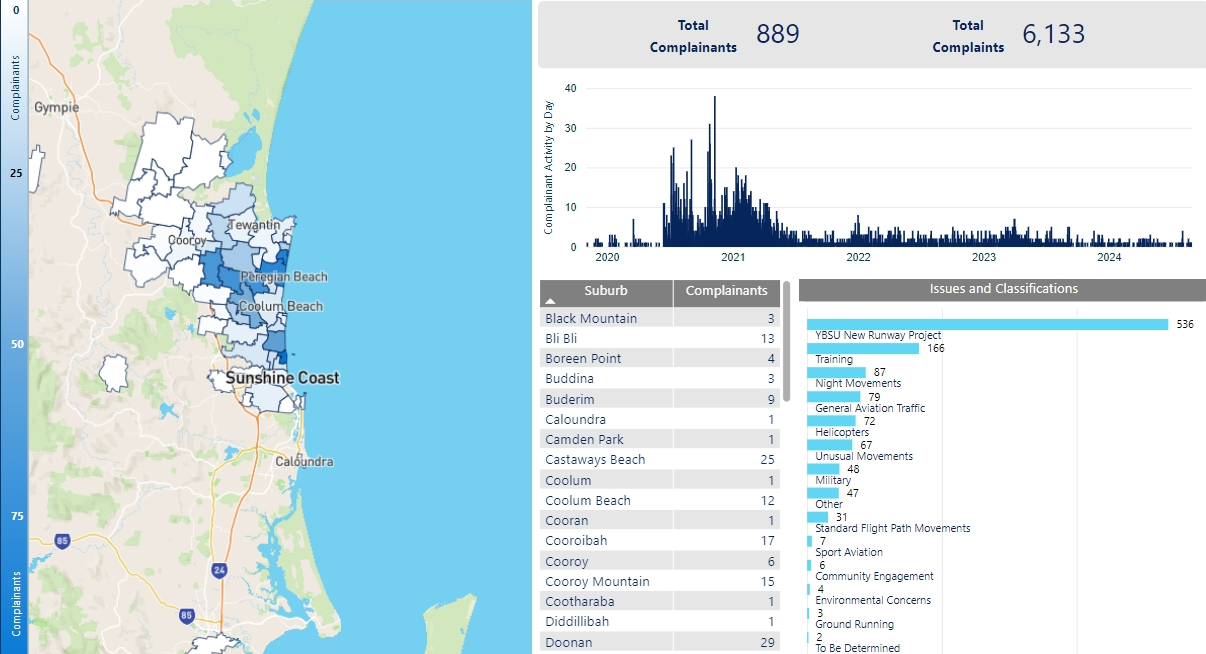
We manage complaints and enquiries about aircraft noise and operations through our Noise Complaints and Information Service (NCIS). The information below is collected for the purpose of complaint management, analysis of issues and identification of causal factors.

For this reason we refer to ‘complainants’ and ‘issues’. Complainants are people who contacted us. While some people submitted enquiries or comments rather than complaints, all are referred to as “complainants”. Issues are the primary concern they raised.

The complaints report

Use this interactive tool to explore the issues raised by residents from different suburbs. For help, click the button in the bottom right-hand corner.

This report is best viewed in full screen mode.

Read an explanation of issues and classifications used in complaint reporting.

How seasonal variation affects your area

Aircraft usually take-off and land into the wind for safety and performance reasons. As the wind direction changes the runway in operation and the flight paths being used may also change.

This means that the Sunshine Coasts seasonal wind patterns affect usage of the different runway directions.

When there are easterly or southerly winds, aircraft approach the runway from an inland direction and depart towards the ocean.

When the wind is from a westerly or northerly direction, the runway is used in the opposite direction.

If the wind is light or calm the direction the runway is used is determined by other factors such as Noise Abatement Procedures (NAP) or air traffic management requirements.

As we gather more data on operations we will update this section with more information.


Learn more about how the runway is named and oriented on our Sunshine Coast Airport Runway page.

Will flights increase in the future in my area?

Flight Path and Airspace Changes

Visit Engage Airservices to engage with our program of flight path and airspace changes.

Airport Master Plans

Airport Master Plans provide a blueprint for the future development of an airport over a twenty year period. They include information on forecast growth, airport terminals and facilities, runways and flight paths.

Who is responsible for master planning?

Airports are responsible for producing the master plan.

Sunshine Coast Airport

The Sunshine Coast Airport Master Plan can be found on the Sunshine Coast Airport website.