Learn about flight paths and aircraft movements in your area
Welcome to the Aircraft in Your Neighborhood Portal
Our goal is that you will learn more about the flight paths and aircraft movements in your area and be able to access the information and resources that explain how air traffic is managed.
First, please select your location using one of the following options, so that we can customize the information for your location.
We’ll remember your location so you don’t have to enter it every time you visit the site and we’ll keep this information confidential.
Please note, that this site works best on Chrome, Firefox and Edge.
* Mandatory - Select region first to view the map.
A designated training area exists to the north-west of the airport and to the west and north-west of the RAAF Edinburgh Base. Once pilots progress past the circuit training stage of their courses they will begin flying to and around the training area.
Click to enlarge the image, right, and use your browser “back” button to return to this page.
The training area is outside controlled airspace. It extends from St Kilda, which is approximately 10 kilometres west-north-west of the airport, to Long Plains, which is a further 45 kilometres to the north-west of St Kilda. The training area is to the west of this line and extends to 9 kilometres off the coast. It is ‘wedge-shaped’ because it is located in-between military restricted airspace to the west and north and the RAAF Edinburgh Base Control Zone to the east.
From the St Kilda area to just south of Middle Beach the training area exists between the surface (“SFC”) and 2500 feet. North to Long Plains the area extends between the surface and 4500 feet. These levels keep the aircraft below controlled airspace; therefore aircraft do not need a clearance from air traffic control to operate in the training area.
Aircraft wishing to track to the training area from Parafield Airport must remain south of the Bolivar strobe light and west of St Kilda to remain outside controlled airspace. The north- and southbound VFR routes (described above) transit the area.
Activities that may occur inside the training area include parachute operations and light aircraft movements at Lower Light aircraft landing area, as well as training flights by light aircraft in and around the area and aircraft transiting on the north and southbound VFR routes. There can be increased traffic volumes in the area due to use by flight training companies from Parafield Airport and because all aircraft are confined to a relatively small area due to the surrounding military airspace including RAAF Base Edinburgh.
Federally-leased airports (excluding Mt. Isa and Tennant Creek) have established Community Aviation Consultation Groups (CACGs), which provide an effective avenue for local community engagement on airport planning and operations, including aircraft noise. The Department for Infrastructure, Transport, Regional Development and Communications provides guidelines for CACGs.
Non federally-leased airports may also choose to establish CACGs or community forums.
CACG membership depends on the characteristics of the airport and any local issues of community concern however, generally includes:
airport management
aircraft operators
community organisations or representatives
representatives from state, territory or local government bodies
local tourism and business groups.
Airservices does not formally belong to CACGs, but is invited to attend to provide relevant information and assist in discussions. We engage with CACGs on flight path and airspace changes, as well as technical reviews, such as noise monitoring and noise abatement procedures.
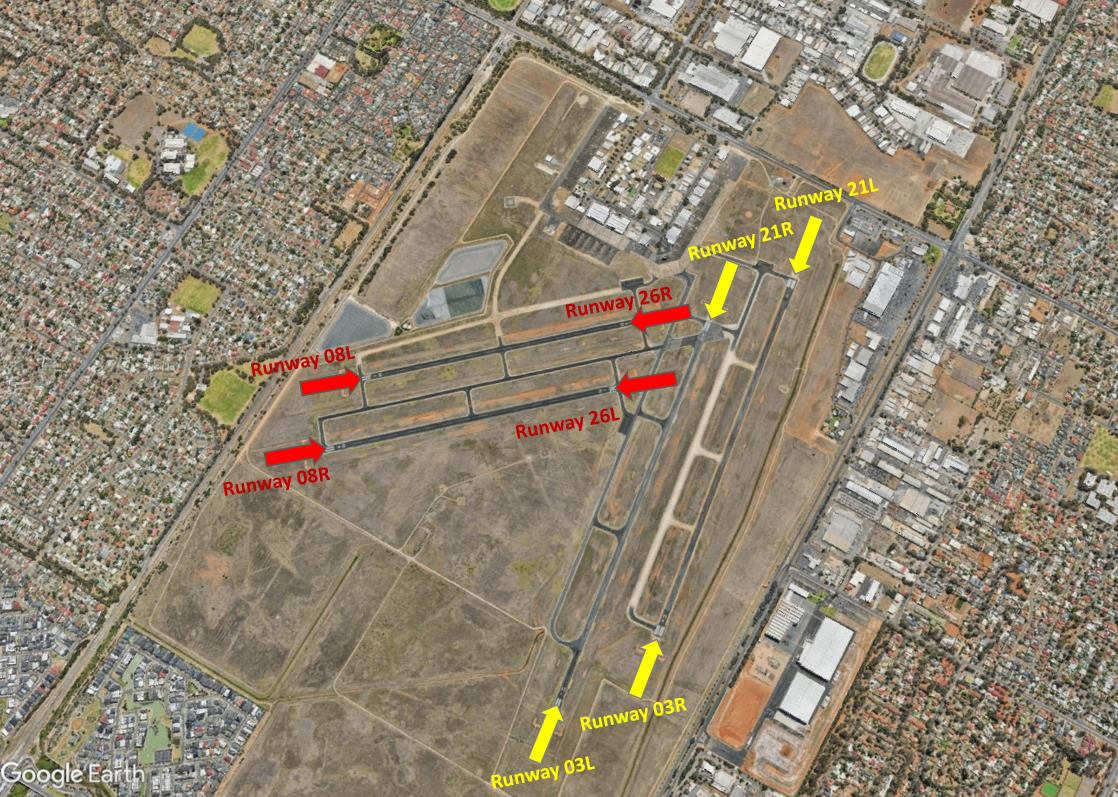
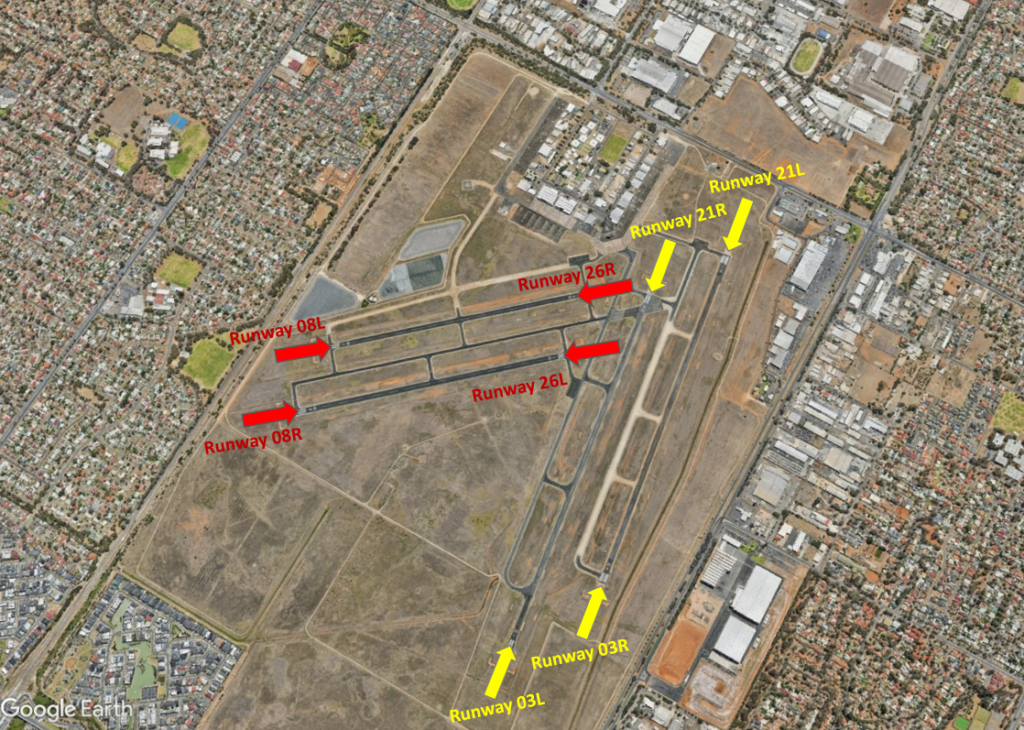
At Parafield Airport there are two sets of parallel runways. One set is orientated east to west (Runways 08 Left/26 Right and 08 Right/26 Left) and the other is orientated north to south (Runways 03 Left/21 Right – 03 Right/21 Left).
Each runway is referred to differently according to in which direction it is being used. For example, the north-south runways are referred to as Runway 03 Left and Right when used in a northerly direction and Runway 21 Left and Right when used in a southerly direction.
Runway numbering reflects the runways’ orientation and correlates with degrees on a compass. Runway 03 is 30 degrees magnetic.
The following video explains how runways are named and used.
Runway selection and seasonal winds
Runway selection is based on wind direction, weather conditions, traffic volume and other factors. See the Runway Selection fact sheet for more details. Aircraft primarily take-off and land into the wind for safety and performance reasons. Therefore, as the wind direction changes the runway in operation may also change depending on the strength of the wind.
This means that Adelaide’s seasonal wind patterns affect usage of the different runway directions. For example, Runways 03 Left and Right tend to be used more often in the cooler months when there are frequent winds with a northerly component. Runways 21 Left and Right tend to be used more frequently in the warmer months when the predominant wind direction tends to be southerly.
Noise abatement procedures
Noise abatement procedures are designed to help reduce the impact of aircraft noise on communities. While they are applied whenever it is possible to do so, their use is not mandatory and is subject to weather conditions and traffic requirements.
Circuit training is only allowed between specific hours. At night, circuit training can only be conducted from the north-south runways to the west. Outside of Tower hours the preferred runway is 03 Left/21 Right.
The majority of aircraft using Parafield Airport fly under Visual Flight Rules (VFR). There are designated routes for VFR aircraft to ensure that VFR traffic remains separate from aircraft flying under Instrument Flight Rules (IFR). It is not mandatory that VFR aircraft fly these routes, but many do, especially as they approach or depart airports.
These routes are outside controlled airspace (“OCTA”), that is, aircraft are not being directed by air traffic control. Whenever they fly outside controlled airspace, pilots are following the rules of the air. More information about airspace is found here.
VFR routes include defined entry and exit points to and from controlled airspace such as that around Parafield Airport. These are landmarks that are easily seen by the pilot from the air. These landmarks are highlighted in the images below, which also show the average percentage of arrivals or departures that use the route.
There is no minimum altitude for aircraft in the process of landing. Aircraft will generally descend on a glide slope of three degrees.
The altitude of aircraft after departure will depend on factors such as the type of aircraft and its weight, how heavily laden it is with fuel and passengers, and the atmospheric conditions at the time. All these factors affect an aircraft’s climb rate. There is no regulated minimum altitude for an aircraft in the process of taking off.
Arrival Routes
The VFR arrival route from the northwest begins at Dublin. Aircraft will be at or below 4500 feet at this point. The route crosses the coast at River Mouth by which time aircraft must not be above 1500 feet. The route then tracks over water to the entry point at Outer Harbor.
From the east aircraft track via Warren Reservoir where they will be below 2500 feet to Little Para Reservoir Dam Wall entry point where they need to be 1500 feet.
From the south the VFR route begins at Tailem Bend and tracks via Strathalbyn where aircraft will be below 4500 feet. It then proceeds to Port Noarlunga where aircraft will stay below 2500 feet. From there aircraft will track up the coast to the Marino Lighthouse. Aircraft will now be at 1500 feet as they fly past the Mitsubishi Car Plant to the Waite Campus of Adelaide University, and then to Hope Valley Reservoir entry point.
Outer Harbor and Little Para Reservoir Dam Wall are the most used entry points.
Departure routes
The VFR exit points are Port Adelaide, St Kilda, Para Substation and Hope Valley Reservoir. St Kilda and Para Substation are the most-used exit points.
Aircraft departing to the north-west will maintain 1000 feet until reaching St Kilda to separate them from arriving aircraft at Outer Harbor which are at 1500 feet. To stay out of controlled airspace, aircraft will avoid climbing above 1000 feet until north of St Kilda. While tracking towards Dublin aircraft will climb to 2500 feet until past Middle Beach where they can climb to at or below 4500 feet.
Departures to the east are via Para Substation, past the GMH complex. Aircraft will maintain 1000 feet until clear of traffic and then climb to 1500 feet. Once clear of the Parafield Control Zone they will climb to not above 2500 feet and track to South Para Reservoir.
Departures to the south may be cleared by air traffic control on the Hope Valley Reservoir route from Waite Campus at Adelaide University to Marino Lighthouse. Alternatively they may be directed to depart via St Kilda from where further clearance to head south is required.
Training area
A designated training area exists to the north-west of the airport and to the west and north-west of the RAAF Edinburgh Base. Once pilots progress past the circuit training stage of their courses they will begin flying to and around the training area.
The training area is outside controlled airspace. It extends from St Kilda, which is approximately 10 kilometres west-north-west of the airport, to Long Plains, which is a further 45 kilometres to the north-west of St Kilda. The training area is to the west of this line and extends to 9 kilometres off the coast. It is ‘wedge-shaped’ because it is located in-between military restricted airspace to the west and north and the RAAF Edinburgh Base Control Zone to the east.
From the St Kilda area to just south of Middle Beach the training area exists between the surface (“SFC”) and 2500 feet. North to Long Plains the area extends between the surface and 4500 feet. These levels keep the aircraft below controlled airspace; therefore aircraft do not need a clearance from air traffic control to operate in the training area.
Aircraft wishing to track to the training area from Parafield Airport must remain south of the Bolivar strobe light and west of St Kilda to remain outside controlled airspace. The north- and southbound VFR routes (described above) transit the area.
Activities that may occur inside the training area include parachute operations and light aircraft movements at Lower Light aircraft landing area, as well as training flights by light aircraft in and around the area and aircraft transiting on the north and southbound VFR routes. There can be increased traffic volumes in the area due to use by flight training companies from Parafield Airport and because all aircraft are confined to a relatively small area due to the surrounding military airspace including RAAF Base Edinburgh.
Visit Engage Airservices to engage with our program of flight path and airspace changes.
Airport Master Plans
Airport Master Plans provide a blueprint for the future development of an airport over a twenty year period. They include information on forecast growth, airport terminals and facilities, runways and flight paths.
Who is responsible for master planning?
Airports are responsible for producing the master plan.