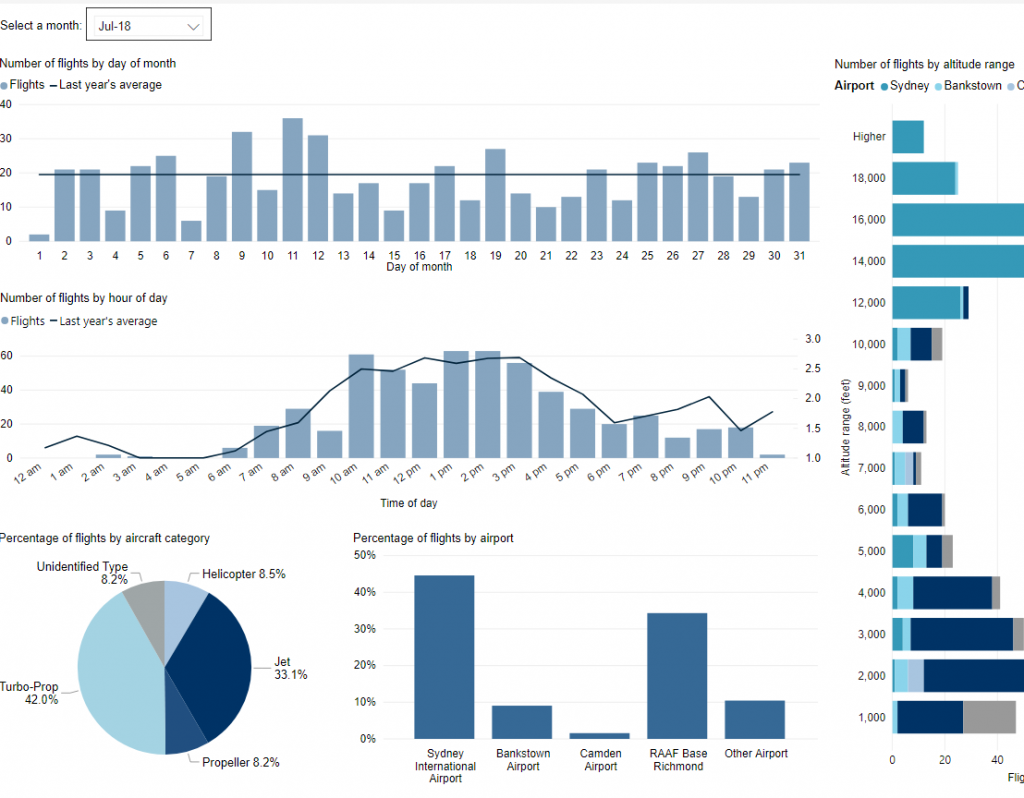
How frequent are flights in my area?

There are a number of factors that influence the frequency of flights.

Firstly, the number and frequency of flights will vary on a daily, weekly and yearly basis due to differences in airline schedules. The airlines schedule flights in response to consumer demand. This is particularly the case around Christmas, Easter, school holidays and Lunar New Year.

Secondly, the runway in use at any given time will also vary, largely due to the wind conditions. Each runway has its own set of flight paths, and each flight path will affect different areas. As the runway in use changes, the flight paths change, and so too do the areas affected by aircraft movements.

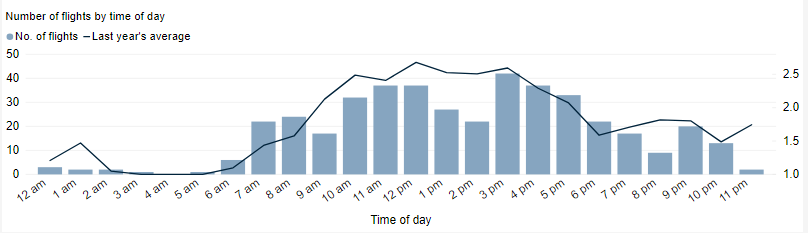
This chart shows the total number of flights each hour over the month, compared to the average for last year. Change the selected month to see how it has varied.

Explore detailed data for your area

Use this interactive tool to explore detailed data for your area in the month of your choice.

This report is best viewed in full screen mode.

When is each flight path used?

Flight paths are not precise, defined paths like runways, but more like corridors that are often several kilometres wide.

Arrivals

Jets arriving from the north tend to follow one of two paths.

Aircraft will generally approach from the north east, crossing the coast at Richter’s Creek, largely avoiding residential areas.

Aircraft using the Instrument Landing System on Runway 15 will approach over land directly from the north, flying over some suburbs. This approach will be used most frequently in poor weather, but international carriers will often use this approach regardless of the weather conditions. This type of approach requires aircraft to be at around 3000 feet when they begin their approach. Aircraft will descend steadily to the runway using the horizontal and vertical guidance provided by the system.

The approach from the south is straight in from the south-east, and passes over the central business district.

There is no minimum altitude for aircraft in process of landing. Aircraft will generally descend on a glide slope of three degrees.

Departures

Departure flight paths allow aircraft to maintain the runway heading for a short time until they are stabilised in flight, and then to turn towards the route that will take them to their destination.

Jet departures to the south turn soon after take-off to the east, crossing over the ocean. Some residential areas are over flown but these are limited to suburbs within four kilometres of the airport, and the central business district is not overflown.

Departures to the north turn to the north-east to cross the coast at Richter’s Creek. This flight path flies over a small number of suburbs.

The altitude of aircraft after departure will depend on factors such as the type of aircraft and its weight, how heavily laden it is with fuel and passengers, and the atmospheric conditions at the time. All these factors affect an aircraft’s climb rate. There is no regulated minimum altitude for an aircraft in the process of taking off.

Smart Tracking

A growing number of modern aircraft are now fitted with navigation systems that use satellite-assisted guidance which allow aircraft to fly with a higher degree of accuracy and more closely follow the same route as other aircraft. Airservices refers to these routes as ‘Smart Tracking’. Smart Tracking technology makes air travel safer, cleaner and more dependable. It also has the potential to improve noise outcomes for communities living close to airports.

In May 2013, Airservices implemented ten permanent Smart Tracking flight paths at Cairns. All but one of these tracks is within previously existing flight paths, and none fly directly over the city. The main benefit of Smart Tracking at Cairns is that more departing and arriving jets will be able to use the Richter’s Creek corridor north of the airport, which means that they avoid residential areas.

Flight path information

You can access historical information about flight path use through WebTrak. To access this information click the “Historical” link below the text in the Quick Start Guide at the top left-hand side of the screen. Then use the tick boxes at the bottom-right of the screen to select monthly, quarterly or yearly information. Use the sliders to refine your selection to specific timeframes.

How seasonal variation affects your area

Aircraft usually take-off and land into the wind for safety and performance reasons. As the wind direction changes the runway in operation and the flight paths being used may also change.

This means that Cairns’ seasonal wind patterns affect usage of the runway directions. The prevailing wind year-round tends to be southerly which results in more use of Runway 15. Therefore, when the wind direction is northerly and Runway 33 is used, it can be more noticeable to affected residents because it occurs less frequently.


Learn more about how the runway is named and oriented on our Cairns Airport Runways page.

Investigation: Helicopter movements over Palm Cove

Around five helicopters a day flew over Palm Cove because of the location of a reporting point. The investigation found that moving the reporting point over water was feasible from a safety and efficiency perspective and would be a noise improvement for Palm Cove. The change was implemented.

Community Aviation Consultation Groups (CACGs)

Federally-leased airports (excluding Mt. Isa and Tennant Creek) have established Community Aviation Consultation Groups (CACGs), which provide an effective avenue for local community engagement on airport planning and operations, including aircraft noise. The Department for Infrastructure, Transport, Regional Development and Communications provides guidelines for CACGs.

Non federally-leased airports may also choose to establish CACGs or community forums.

CACG membership depends on the characteristics of the airport and any local issues of community concern however, generally includes:

  • airport management
  • aircraft operators
  • community organisations or representatives
  • representatives from state, territory or local government bodies
  • local tourism and business groups.

Airservices does not formally belong to CACGs, but is invited to attend to provide relevant information and assist in discussions. We engage with CACGs on flight path and airspace changes, as well as technical reviews, such as noise monitoring and noise abatement procedures.

Find out more information on the Cairns Community Aviation Consultation Groups (CACGs).

Investigation: Runway 15 departure turns

The Airport Environmental Consultative Committee requested an investigation into concerns that some airlines were not performing the required turn correctly after departure from Runway 15. Aircraft are required to begin their turns at the earlier of the end of the runway or when they reach 400 feet. Non-compliance is followed up by air traffic control.

Data on 4178 jet departures from July to November 2016 was analysed. The investigation found that variations in the turns were not confined to any one airline, and were the result of the differing turn performance of different aircraft types. While aircraft were beginning their turns at the correct point in flight, some aircraft types would take longer to complete the turn than others, creating a wider arc.