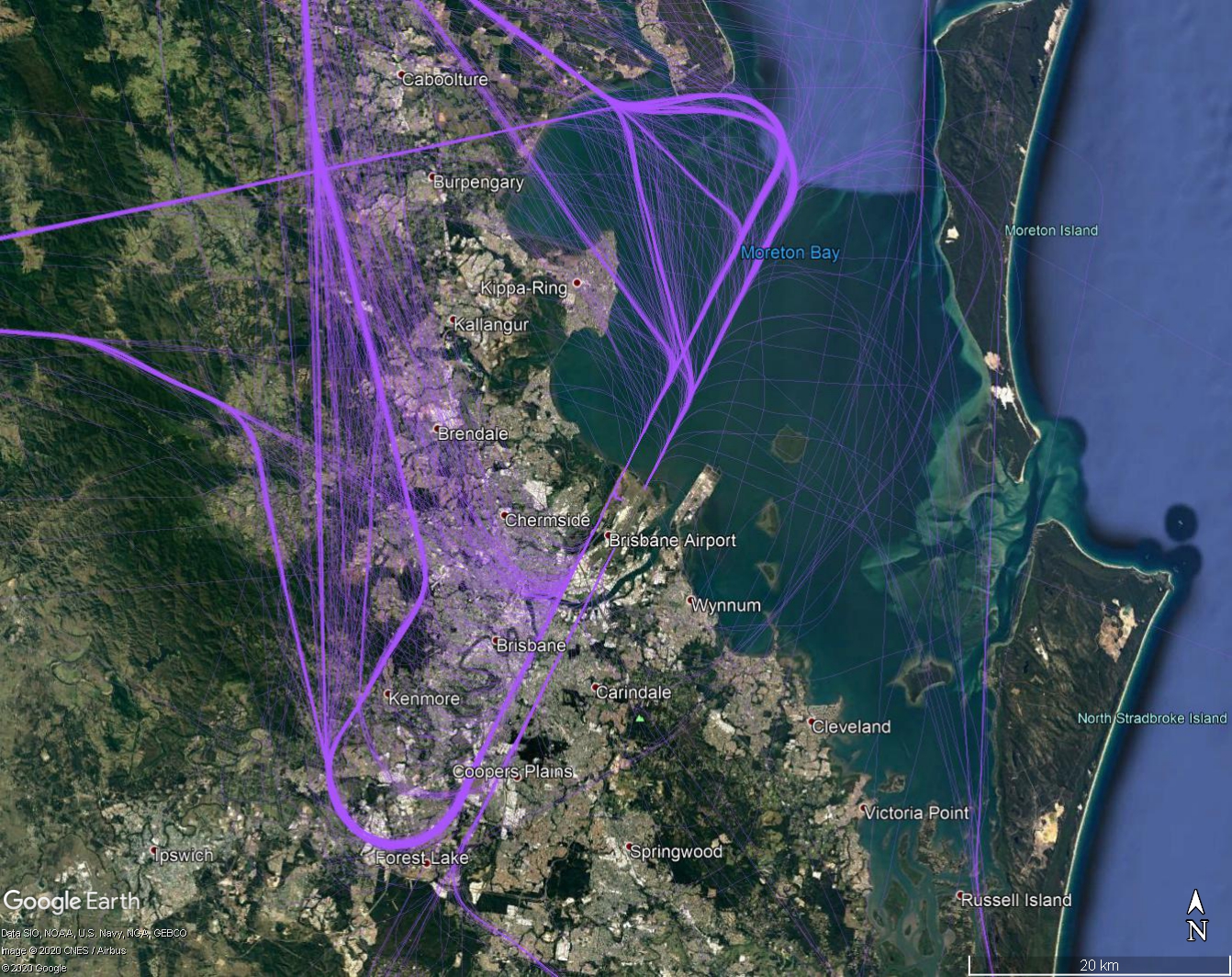
Learn about flight paths and aircraft movements in your area
Welcome to the Aircraft in Your Neighborhood Portal
Our goal is that you will learn more about the flight paths and aircraft movements in your area and be able to access the information and resources that explain how air traffic is managed.
First, please select your location using one of the following options, so that we can customize the information for your location.
We’ll remember your location so you don’t have to enter it every time you visit the site and we’ll keep this information confidential.
Please note, that this site works best on Chrome, Firefox and Edge.
* Mandatory - Select region first to view the map.
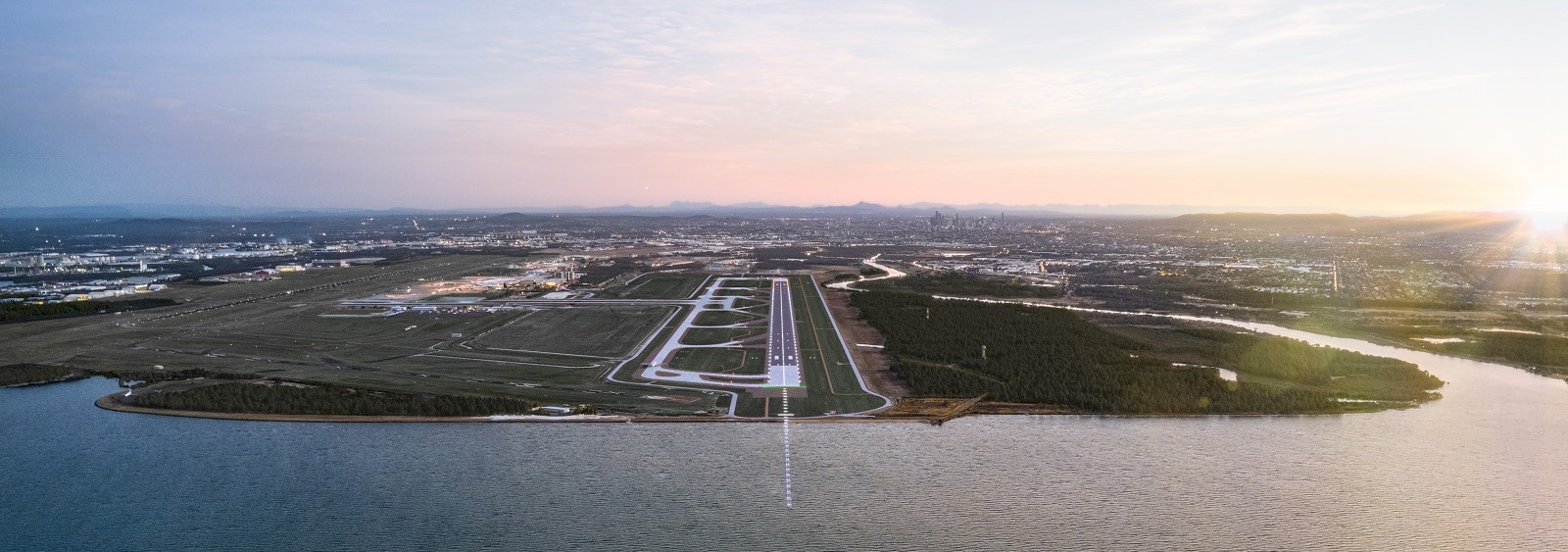
Brisbane’s new runway commenced operations on 12 July 2020 .
Brisbane Airport Corporation and Airservices are working with stakeholders across community, government and industry to ensure that the Brisbane Airport operations meet the highest safety standards and incorporate the most environmentally sustainable practices, wherever practicable.
Airservices conducted a Post Implementation Review (PIR) of the flight paths and airspace changes implemented to support parallel operations, and the associated aircraft noise impacts. The final PIR report, released in 2022, recommended a series of actions to improve noise outcomes for the community. These are being delivered through the Noise Action Plan for Brisbane.
We are currently working through the recommendations and presenting options as they are developed to the community for feedback. Our immediate priorities are actions which aim to:
Reduce the impact of over-water operations that fly over communities as aircraft cross the coastline
Reduce the impact of night-time operations on communities
Extend the use of Simultaneous Opposite Direction Parallel Runway Operations (SODPROPS) and other over-water operations
Reduce the concentration of operations over communities.
You can visit the Noise Action Plan for Brisbane page on Engage Airservices to register to stay up to date with our engagement and the options as they are developed and implemented.
It is important to note that NAPs are not mandatory; ATC and pilots apply the NAPs whenever possible. The published NAPs at Brisbane airport state that ATC will maximise the use of preferred flight paths and over-water operations. Pilots and ATC will determine when critical operational requirements override the use of NAPs.
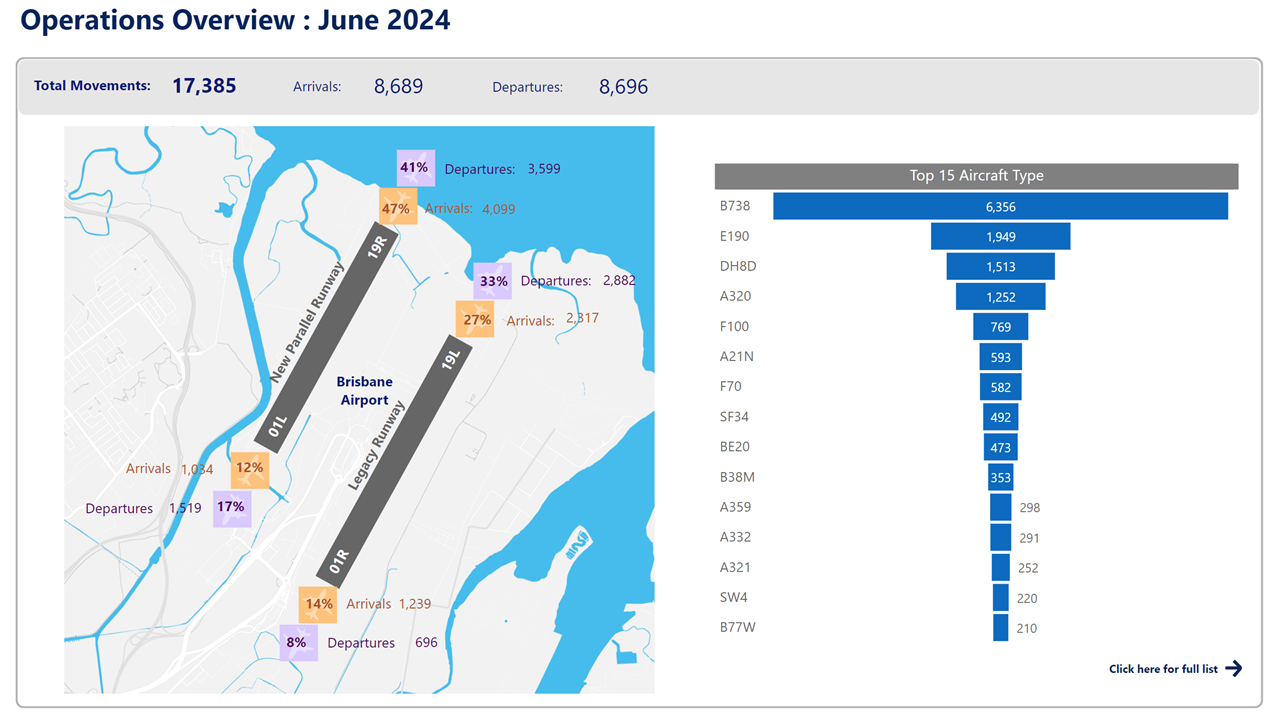
The below overview provides monthly movement numbers, runway end usage, and the types of aircraft operating at Brisbane airport. Note that the percentages shown at each end of the runway represent the proportion of arrivals or departures using that direction.
This report was updated on 6 November 2025 and now shows daily data from midnight to 11:59pm to better reflect full-day activity. It previously showed 24-hour data from 6am to 6am.
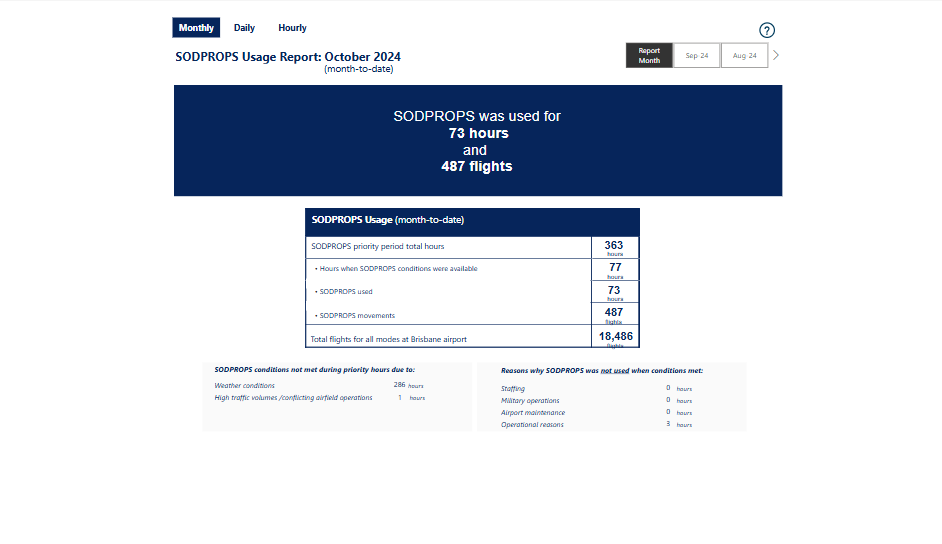
SODPROPS mode is prioritised for use where weather and traffic conditions allow.
The following conditions must be met:
dry runway
less than 5 knot tailwind
cloud base not below 2,500 ft (762 metres)
8 km visibility
low traffic levels.
The mode is most likely to be used during the following hours:
9pm to 6am six days a week
6am to 8am Saturday and Sunday mornings
12noon Saturday to 4pm Sunday.
Improving our reporting
Airservices Australia is committed to providing clear, accurate, and transparent reporting to the community. We began monthly reporting on SODPROPS use in June 2024 and have continued to review and refine the methodology used to prepare these reports.
We have updated the methodology used to report SODPROPS availability. These changes apply from the June 2026 report onwards and do not change how SODPROPS is operated or how SODPROPS flights are counted as a total percentage of flights at Brisbane Airport.
The updated methodology will include periods of unstable weather conditions, and times when forecasts indicate that SODPROPS conditions will not be available for at least 45 minutes, in the total time reported as “SODPROPS conditions not met during priority hours, due to weather conditions”. These situations have been reported separately to this point, but as they relate to the availability of the required weather conditions to operate SODPROPS, they will now be presented collectively. We are also expanding our reporting on “operational reasons” to better explain the constraints that can prevent the use of SODPROPS when weather conditions allow.
Additional SODPROPS use
Additional SODPROPS movements may be recorded when conditions were not available. This is primarily due to transition periods. These occur when SODPROPS is in operation and the system identifies that suitable conditions are no longer available but some aircraft will already be planned on SODPROPS flight paths. These flights will continue their departure or landing as planned, when safe to do so. This could be several minutes after the system notes SODPROPS conditions have ended.
These extra SODPROPS movements were captured in February 2025 reporting, and we have now updated the report structure to separate these extra movements from movements during available conditions. This will apply to reporting from February 2025 on. Previous months only captured SODPROPS movements during available hours and these reports will not be changed. The new structure reports on use and movements during available conditions on the left of the page and movements outside of these conditions on the right.
Rounding of hours
For simplicity, the reporting now uses whole hours rather than hours and minutes. Results of 30 minutes or more are rounded up to the next hour and less than 30 minutes are rounded down.
Note: On 1 December 2025, Brisbane Airport Corporation (BAC) commenced an 18 month trial to collect data on tailwind operations, continuing long term efforts to safely reduce overnight aircraft noise for local communities. When operational conditions permit, this voluntary, opt-in trial allows participating pilots to depart from the eastern runway (01R) in tailwind conditions between 5 to 10 knots during overnight hours (10pm to 6am). These movements are not included in our SODPROPS Usage report.
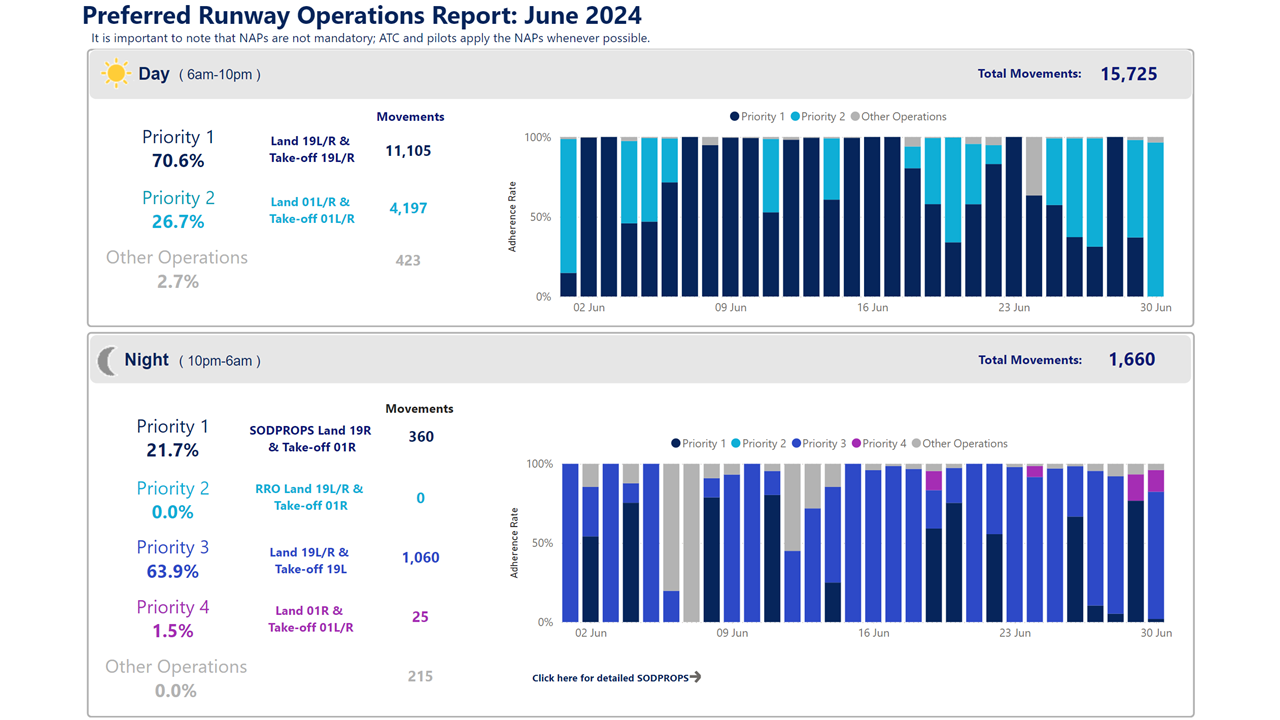
This NAP lists the preferred runway operating modes during the daytime period (6am-10pm local) and night-time period (10pm-6am local):
During the daytime period (6am-10pm local):
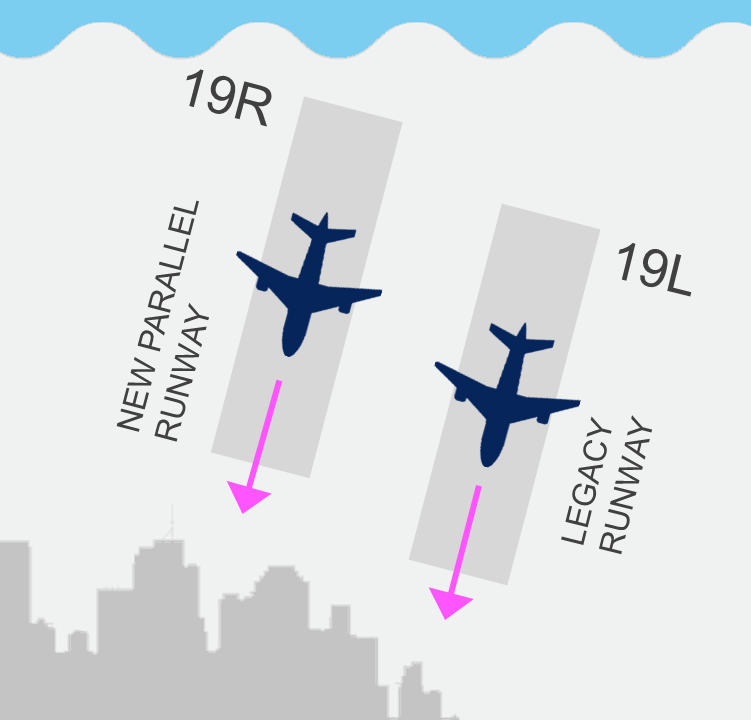
Priority 1: Arriving and departing – Runways 19L/R (arriving over the waters of Moreton Bay and departing over Greater Brisbane)
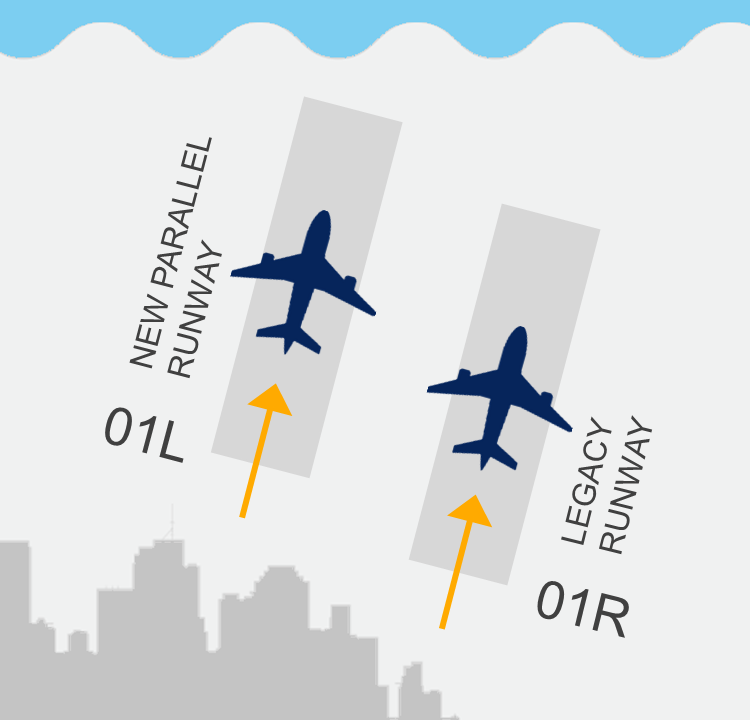
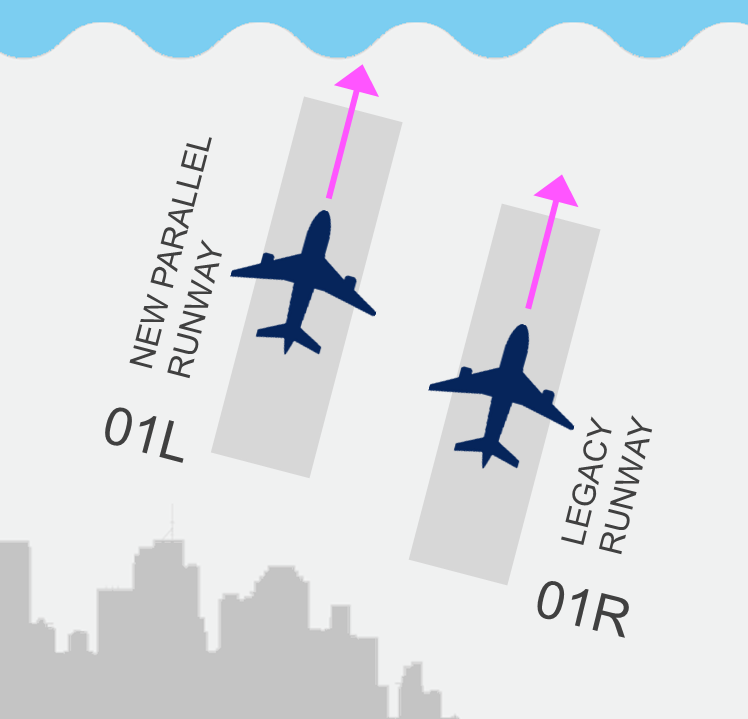
Priority 2: Arriving and departing – Runways 01L/R (arriving over the Greater Brisbane and departing over the waters of Moreton Bay)
During the night-time period (10pm-6am local):
Priority 1: Arriving Runway 19R and departing Runway 01R (Simultaneous Opposite Direction Parallel Runway Operations, SODPROPS) (arriving and departing over the waters of Moreton Bay)
Priority 2: Arriving Runway 19L/R and departing Runway 01R (Reciprocal Runway Operations, RRO) (arriving and departing over the waters of Moreton Bay)
Priority 3: Arriving Runways 19L/R and departing Runway 19L (arriving on both runways over the waters of Moreton Bay and departing via the legacy runway over land)
Priority 4: Arriving Runway 01R and departing Runways 01L/R (arriving via the legacy runway over land and departing off both runways over the waters of Moreton Bay)
During night-time hours (10pm-6am local) operations over land via the new runway (19R departures/01L arrivals) are only permitted in emergency, loss of infrastructure, or extreme weather conditions. Any operations outside of these conditions require BAC approval.
The report is best viewed in full screen mode. For instructions on how to use this tool, select the Help button.
This report was updated on 6 November 2025 and now shows daily data from midnight to 11:59pm to better reflect full-day activity. It previously showed 24-hour data from 6am to 6am.
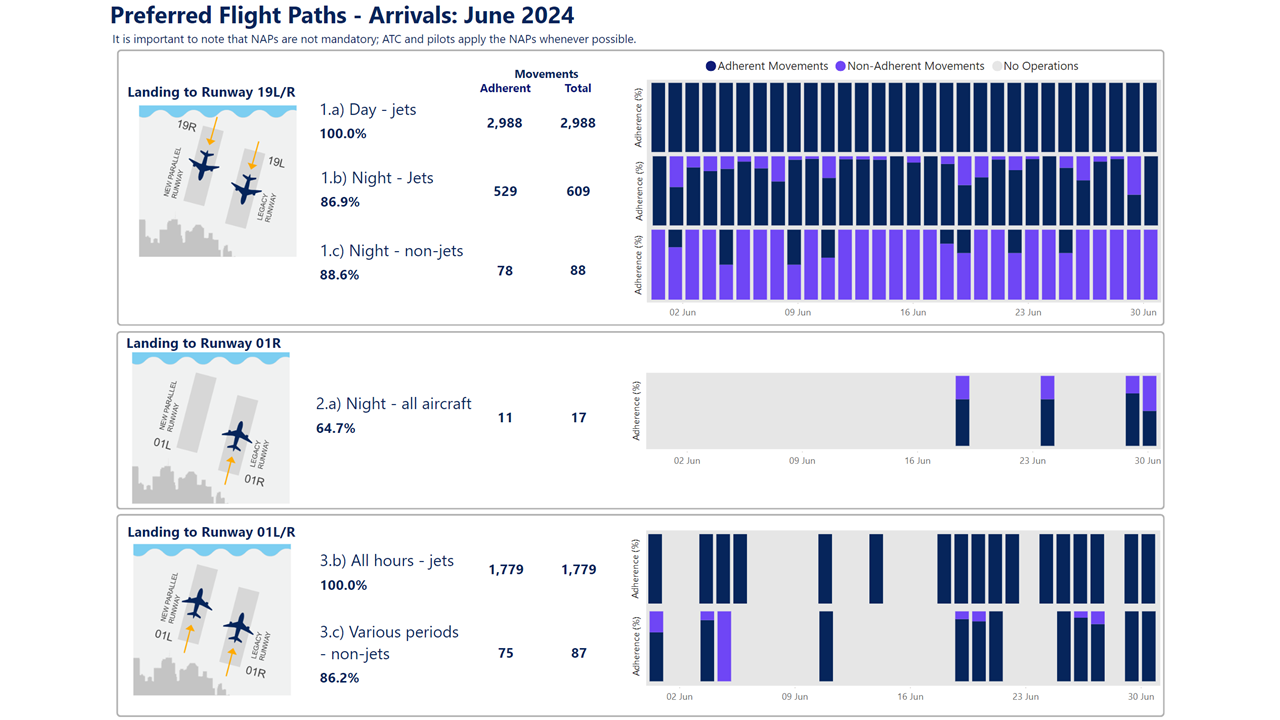
This NAP lists the preferred arrival flight paths to be used by different aircraft at different times throughout the day.
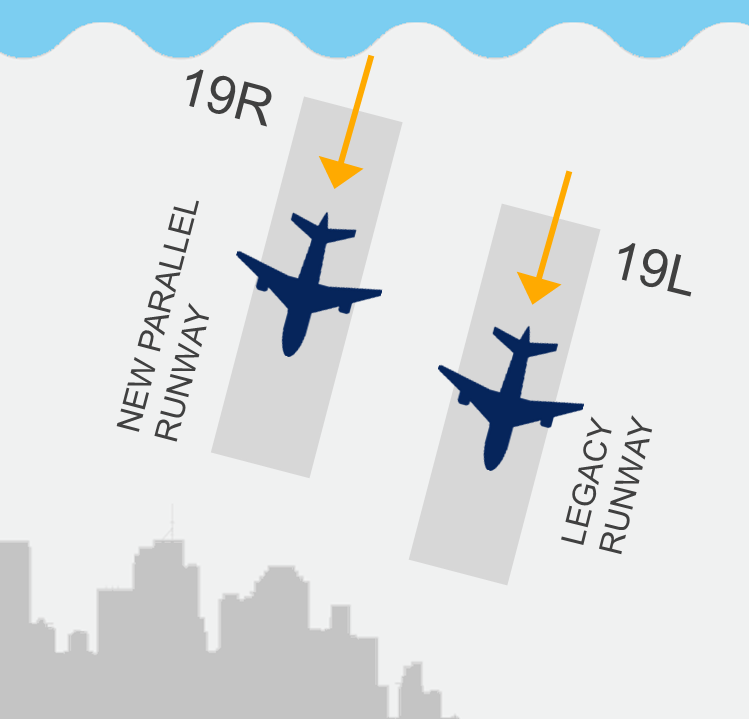
4.1.1 Aircraft Arriving on Runways 19L/R (arriving over the waters of Moreton Bay):
4.1.1 a Between 6am-10pm local, all jet aircraft will not normally descend below 3000ft (914m) until east of the coastline.
4.1.1 b Between 10pm-6am local, descent below 5000ft (1524m) is not permitted for all jet aircraft until east of the coastline.
4.1.1 c Between 10pm-6am local, descent below 3000ft (914m) is not permitted for all non-jet aircraft until east of the coastline.
Reported below.
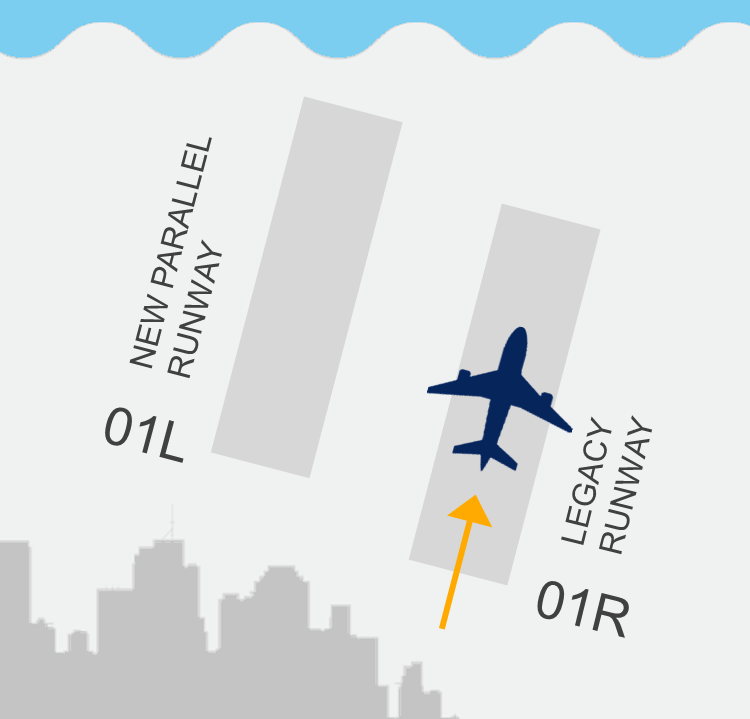
4.1.2 Aircraft Arriving on Runway 01R (arriving over the Brisbane population onto the legacy runway):
4.1.2 a Between 10pm-6am local, all aircraft shall not descend below 3000ft (914m) until aligned with the Runway 01R extended centreline.
Reported below.
4.1.3 Aircraft Arriving on Runway 01L/R (arriving over the Brisbane population):
4.1.3 a Use, as the final landing flap setting, the minimum certified landing flap setting approved by the operator for the applicable conditions. Reporting on this NAP is currently unavailable. Airservices is working to source the additional information needed to provide a report.
4.1.3 b For jet aircraft conducting a visual approach, Air Traffic Control (ATC) will issue an instruction to join final approach for landing south of the Brisbane River. Reported below.
4.1.3 c For non-jet aircraft heavier than 5700KG conducting a visual approach, ATC will issue an instruction to join final approach for landing south of the Brisbane River when the estimated time of arrival is:
Between 8pm-11pm local
Between 6am-12pm local
Reported below.
The report below provides the percentage of flights that adhered to the arrival flight path conditions under the NAP.
The report is best viewed in full screen mode. For instructions on how to use this tool, select the Help button.
This report was updated on 6 November 2025 and now shows daily data from midnight to 11:59pm to better reflect full-day activity. It previously showed 24-hour data from 6am to 6am.
This NAP lists the preferred departure flight paths to be used by different aircraft throughout the day.
Aircraft generally depart under Instrument Flight Rules (IFR) at Brisbane Airport via either a Procedural Standard Instrument Departure (SID) or a Radar SID:
A procedural SID is a published route aircraft use to safely travel through the busy airspace surrounding airports. Aircraft follow this route from departure to where they transition to the enroute (high-level airspace) phase of their flight. Procedural SIDs act like a road, providing an established path for aircraft to track along. They make separation from other aircraft easier and air traffic control more predictable.
A radar SID is a type of departure where Air Traffic Control (ATC) instructs the pilot to travel towards an assigned compass heading (i.e. a direction) once they reach a nominated height. The compass heading depends on the direction of travel but is also used to safely separate aircraft in the same vicinity. The use of Radar SIDs means aircraft are directed individually by ATC over a wide area. This means more residences may be overflown and with less predictability than if procedural SIDs were in use.
It is important to note that jet aircraft may be cleared via a radar SID when required for weather, traffic management, or when a pilot cannot accept a procedural SID. When this occurs, aircraft will be directed as closely as possible to comply with the applicable day or night operations NAP.
4.2.1 Aircraft departing on Runways 19L/R (departing over the Brisbane population):
4.2.1 a: Jet aircraft will normally be assigned a procedural SID. This NAP focuses on whether a procedural SID has been assigned; however, the report provides the percentage of flights that have adhered to flying within a corridor extending 1852m on either side of the centreline.
4.2.1b: Non-jet aircraft will normally be assigned a radar SID. Data not available.
4.2.1c: Non-jet aircraft turn left to establish over water to 5000ft from 10pm to 6am local time. Reported below.
4.2.2 Aircraft departing on Runways 01L/R (departing over the waters of Moreton Bay):
4.2.2a: Jet aircraft will normally be assigned a procedural SID. This NAP focuses on whether a procedural SID has been assigned; however, the report provides the percentage of flights that have adhered to flying within a corridor extending 1852m on either side of the centreline.
4.2.2b: Non-jet aircraft will normally be assigned a radar SID. Data not available.
4.2.2c: Between 10pm-6am local, all aircraft will be contained over water until above 5000ft (1524m). Reported below.
The report below provides the percentage of flights that adhered to departure flight path conditions under the NAP.
This report was updated on 6 November 2025 to display daily data from midnight to 11:59pm for 4.2.2.c, providing a complete view of full-day activity. Previously, it presented 24-hour data based on a 6am to 6am cycle.
The report is best viewed in full screen mode. For instructions on how to use this tool, select the Help button.
While jet aircraft usually fly on published flight paths, turbo-propeller or turbo-prop aircraft (non-jet) have a range of different performance capabilities and therefore fly in a range of ways.
Some turbo-props fly on the published instrument arrival flight paths, while others use the published visual approaches which includes vectoring from air traffic control (ATC).
Turbo-prop departures are allocated headings by ATC based on their destination. This is to keep them safely separated from jet operations, due to differences in aircraft capability (for example speed and altitude of operations), and to maintain a steady flow of traffic.
This means we see a broad area where turbo-props may fly.
Impact of COVID-19 on aircraft operations
Aircraft are flying in accordance with the published procedures. The impacts of COVID-19 restrictions, and the subsequent reduction in interstate jet traffic movements during border closures, resulted in a different distribution of traffic across flight paths and areas of operation.
This is because air traffic control has not needed to use parallel runway operations due to the lower traffic levels.
This has resulted in a greater spread of turbo props outside of the ’swathe’ of operations than we expected.
Turbo props use a mix of jet and non-jet flight paths including visual approaches. A visual approach is when a pilot is operating the aircraft by visual references. This approach can therefore vary by several kilometres.
Changes to turbo-prop operations
We have worked closely with Brisbane Airport to understand the safety and traffic management requirements during this period of disruption.
We will implement a temporary Noise Abatement Procedure to adjust the traffic spread to match what would have been experienced had COVID-19 not affected traffic volumes. This will increase operations in the areas between the short and long approaches (the swathe) during periods of high demand, while the shorter visual approach will still occur when traffic volumes are generally lower.
This temporary procedure will be in place until operations increase to both runways, which will then result in a similar traffic management outcome – with more aircraft operating within the ‘swathes’.
Turbo props will continue to fly visual approaches after we return to parallel runway operations, generally in non-peak times.
Arrivals
Turbo-props need to be managed to make sure they can safely arrive along with jet operations. When the airport is busier, turbo-props more commonly arrive using the published flight paths so they can be safely separated from the jet aircraft traffic by air traffic control.
As there has been low jet traffic at Brisbane airport, turbo props were able to conduct visual approaches and arrive on a more direct path to the runway from their locations.
With borders opening and traffic levels increasing to the existing runway, more turbo-prop aircraft will be required to fly on the published instrument flight paths as they are processed in parallel with jet traffic to both runways.
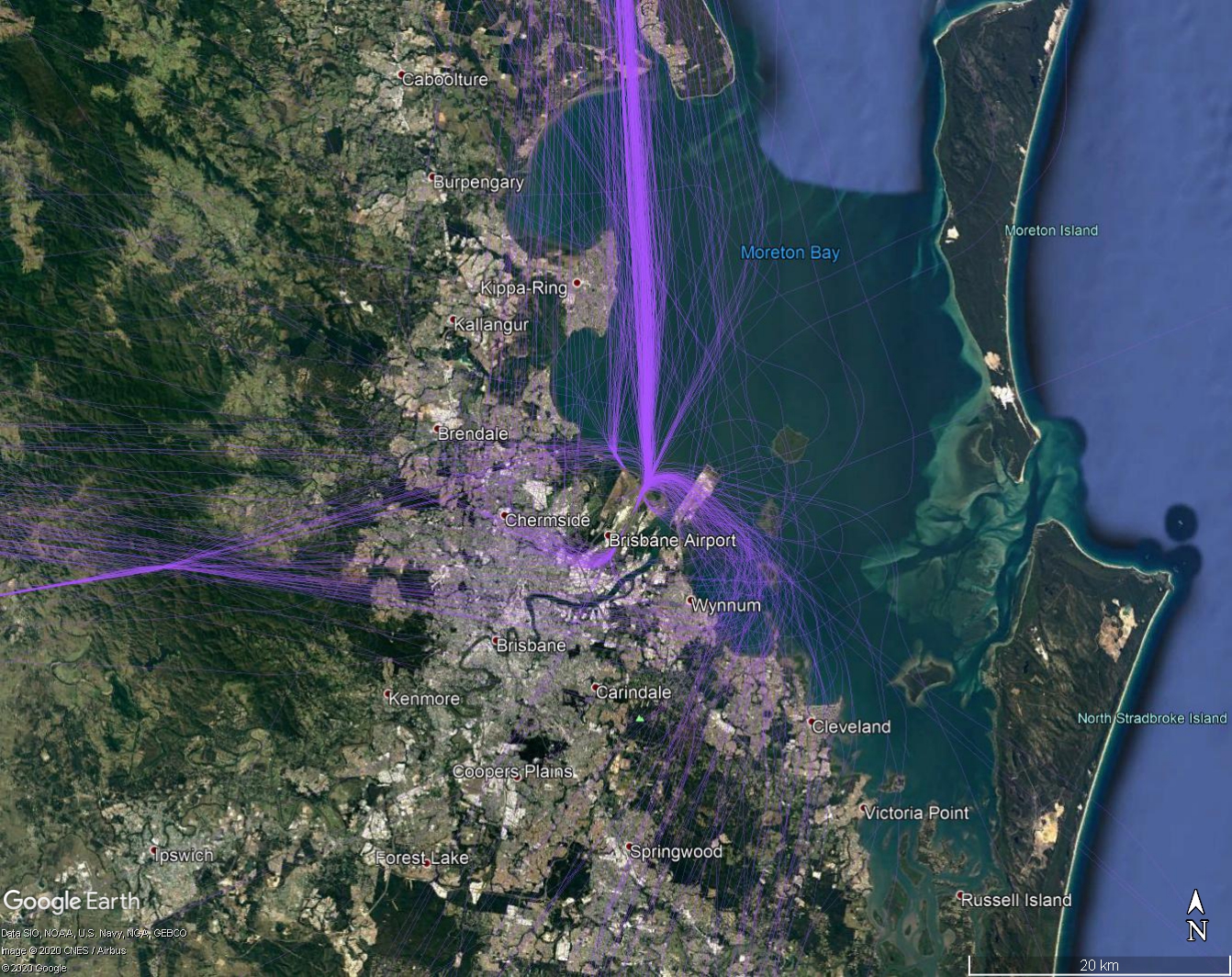
Turbo-prop arrivals to legacy runway (purple) – September 2019
The image above shows pre-COVID levels of turbo-prop arrivals with traffic arriving from both northern and southern locations.
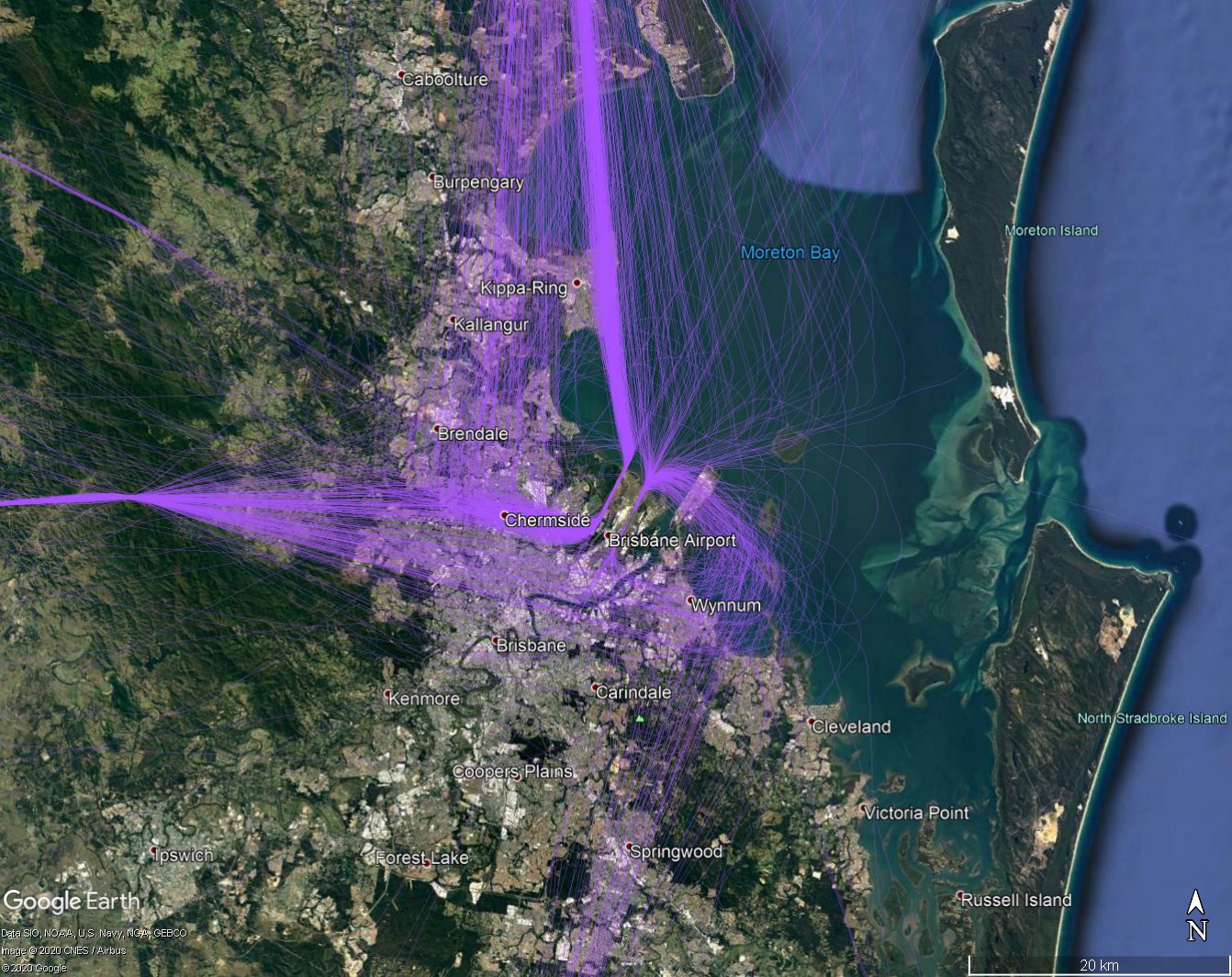
Turbo-prop arrivals to legacy runway and new runway (purple) and – September 2020
The image above shows an overall reduction in turbo-prop arrivals, with the majority of remaining flights arriving from northern (intrastate) locations to the new runway (Runway 19R/01L).
Click on the images above to open a larger view in a new tab.
Departures
Turbo-props are usually assigned a heading at the departure end of the runway, depending on their destination. You will notice that turbo-prop aircraft using the legacy runway at night are quite spread out.
With borders opening and traffic levels increasing to the existing runway, more turbo-prop aircraft will depart from the existing runway.
Turbo-prop departures from legacy runway (purple) – September 2019
The image above shows pre-COVID levels of turbo-prop departures with traffic departing from both northern and southern locations.
Turbo-prop departures from legacy runway and new runway (purple) – September 2020
The image above shows an overall reduction in turbo-prop departures but a wider spread, with the majority of remaining flights departing to northern (intrastate) locations from the new runway (Runway 19R/01L).
Click on the images above to open a larger view in a new tab.
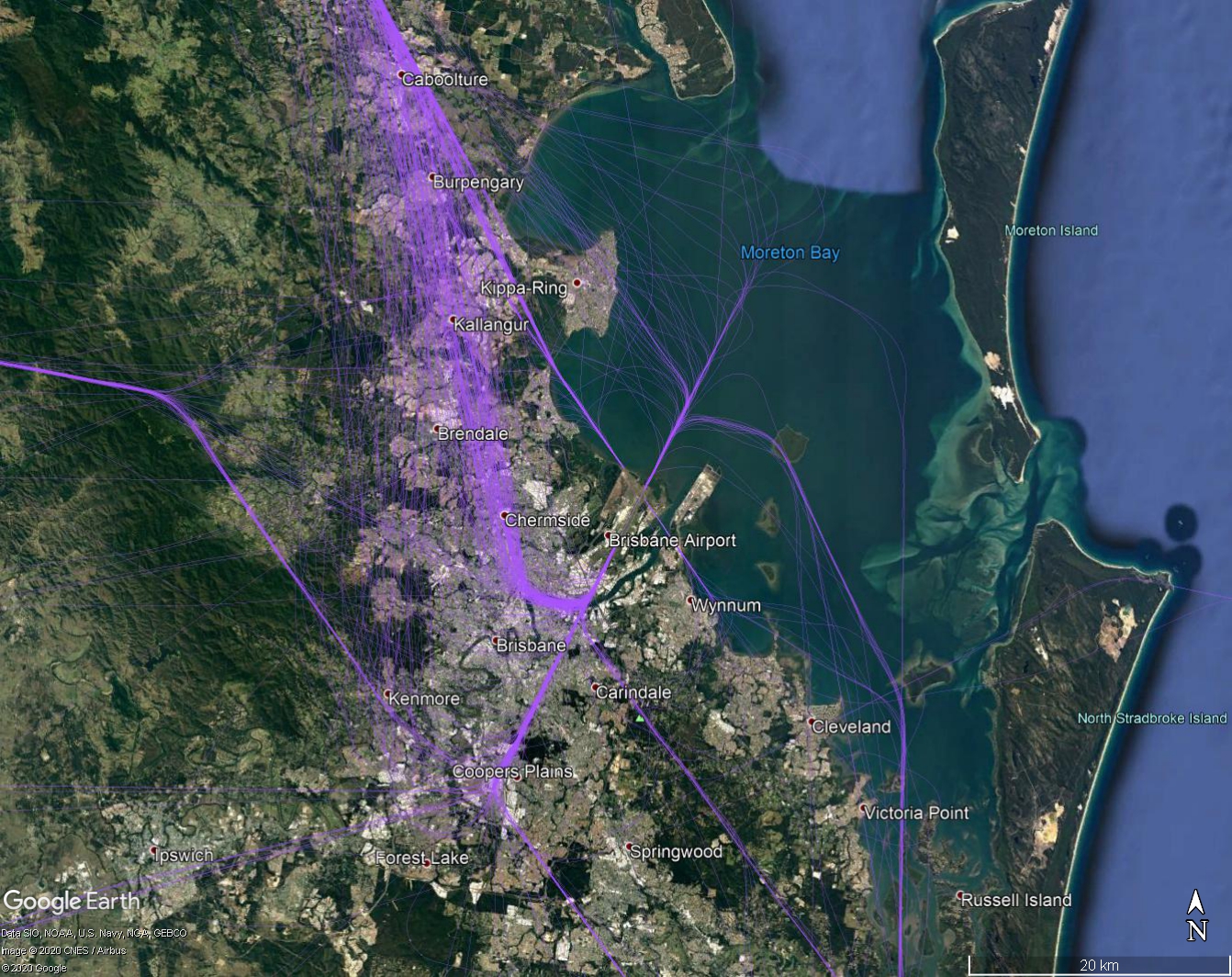
Note: All tracks during the stated month have been displayed. Track colours have been adjusted to show track density. Where aircraft are more concentrated the colour will appear darker.