

Western Sydney Airport noise abatement
Noise Abatement Procedures
Every major airport has Noise Abatement Procedures (NAPs), which are procedures designed to reduce the impact of aircraft noise on the community. There are some limitations to the use of NAPs and they may not be used if they generate delay and congestion, as this can cause noise and emission impacts. Air traffic control or pilots may not be able to use them in certain situations, for example weather conditions or operational requirements.
The main Noise Abatement Procedures currently in use at Western Sydney Airport are:
Preferred runways
Air traffic control nominates the runway for use to ensure safety and operational requirements are met, depending on the weather conditions. If weather conditions do not favour a specific runway, the ‘preferred’ runway is used, the preferred runways for the day time and overnight period, are outlined below
- During the day period (5:30am to 11pm), providing wind and traffic management safety requirements permit, Runway 23 is the preferred runway
- During the overnight period (11pm to 5:30am), providing wind and traffic management safety requirements permit, Reciprocal Runway Operations (RRO) is the preferred runway. RRO is only available overnight and can only be used when very specific weather and traffic conditions are met. More information about RRO can be found in the factsheet here. If RRO cannot be used, Runway 23 is the next preferred runway.
Noise Abatement Procedure (NAP) for Reciprocal Runway Operations (RRO)
RRO is the preferred runway mode between 11pm and 5.30am with an aim to provide the best noise minimisation outcomes for the surrounding communities.
A NAP for RRO has been developed to further minimise these impacts by tactically directing aircraft off the designated flight paths and around communities when lower traffic volumes allow. Aircraft departing to the north or west will continue straight for approximately 5 nautical miles (9.3km) rather than immediately turning. From this point, ATC will tactically direct aircraft to remain south of the Great Western Highway avoiding communities until they join the published flight path over the National Park west of Katoomba (see image below).
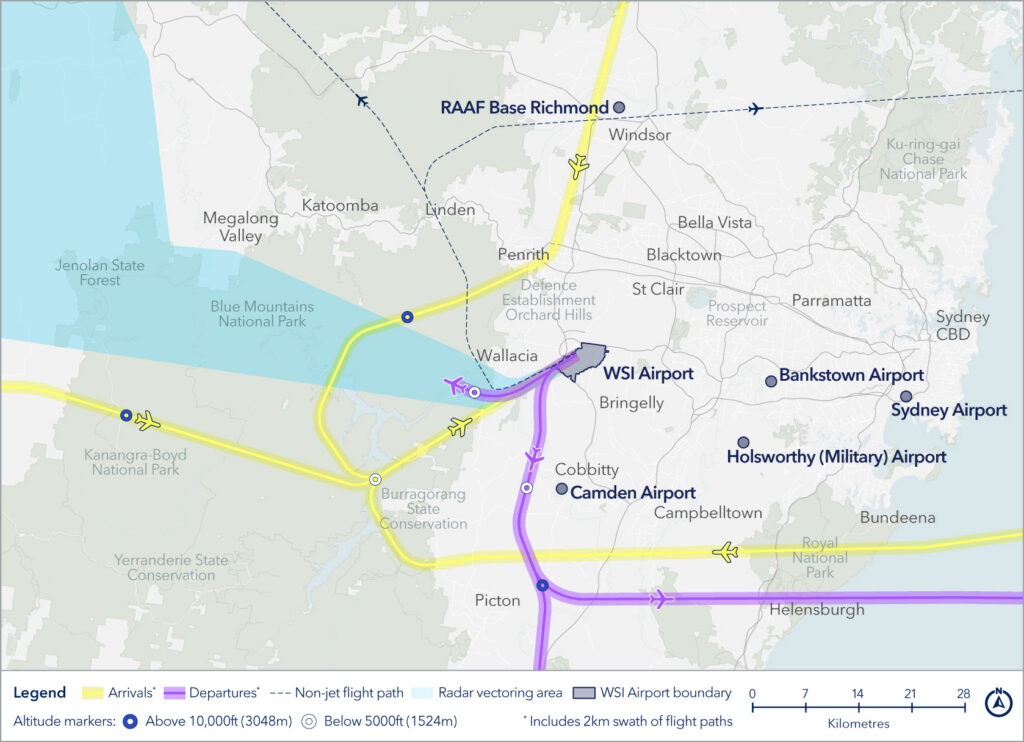
The availability of RRO is dependent on suitable weather conditions, the location of arriving traffic to enable clear airspace and when air traffic volumes are low enough to permit safe operations. The number of movements per hour under RRO will decrease over time as the airport’s traffic volume grows.
Noise Abatement Departure Procedures (NADPs)
When applied by pilots NADPs can reduce the noise impact during departure. The noise reduction outcome depends on the type of aircraft, engine type, thrust required, and the height at which thrust is reduced.
At Australia’s major airports, NADPs are generally required over residential areas to reduce aircraft overflight noise in the first 20km of flight. More information about NADPs at WSI can be found in the Noise Abatement Procedures factsheet.
Community feedback identified a preference for NADP2, which reduces noise over areas more distant from the runway end by prioritising increasing forward speed after take-off. Thrust is reduced at 800ft, and flaps are retracted between 800ft and 3000ft to slow down the climb, keeping aircraft lower closer to the airport. At 3000ft the aircraft will accelerate and increase its angle to gain height, so they can rapidly gain altitude to be higher over communities further from the airport. As a result, pilots will be asked to prioritise NADP2 where possible.
Noise preferential flight paths (daytime vs. overnight)
Noise preferential flight paths are used to direct aircraft away from residential areas, where possible. This includes the use of different flight paths between 11pm and 5.30am, when additional airspace flexibility is available because of the curfew at Sydney Kingsford Smith Airport.